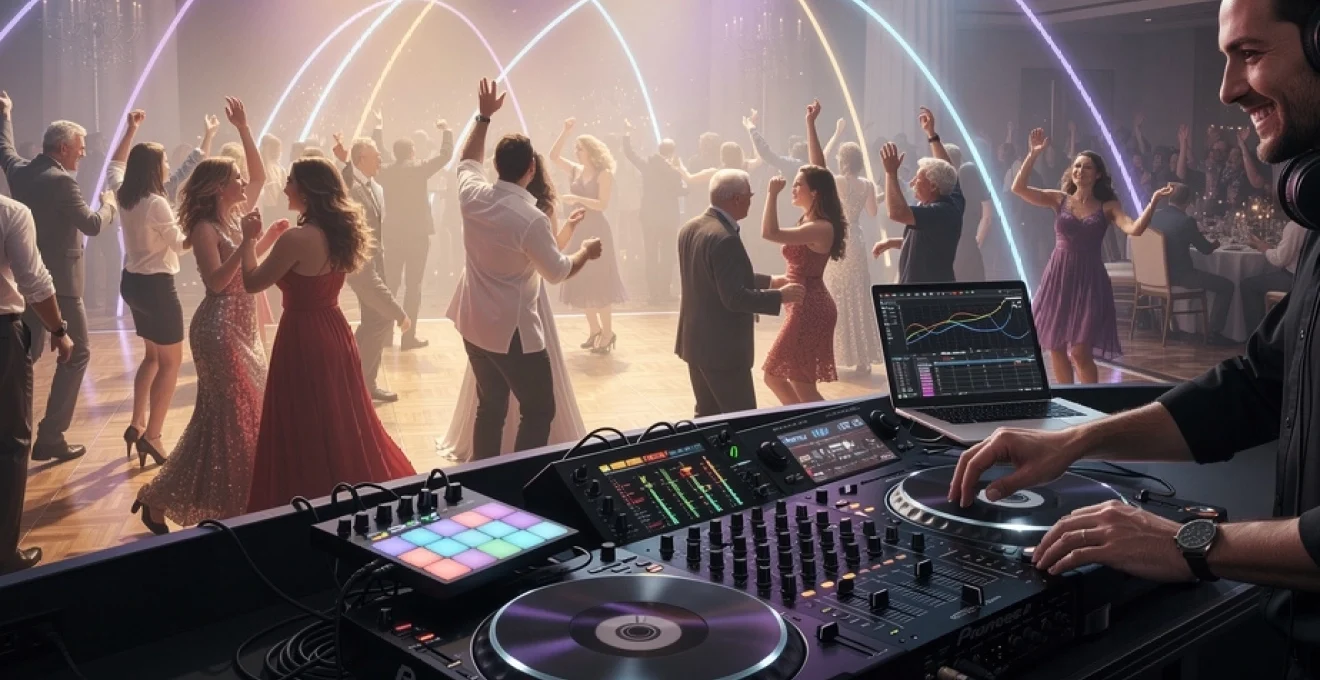
Creating an unforgettable dance floor experience requires more than simply queuing up popular songs and hoping for the best. The art of keeping guests moving throughout an entire evening demands a sophisticated understanding of musical psychology, crowd dynamics, and strategic programming techniques that professional DJs have refined over decades. Whether you’re planning a wedding reception, corporate celebration, or private party, the difference between a memorable night and one that falls flat often comes down to how expertly you navigate the complex interplay between tempo, genre, and audience energy levels.
The modern party landscape has evolved dramatically, with guests expecting seamless transitions between musical eras and styles that cater to multiple generations simultaneously. Today’s successful events blend everything from classic disco and Motown to contemporary chart-toppers and underground dance music, creating an inclusive atmosphere where everyone finds their moment to shine on the dance floor. This delicate balance requires both technical expertise and intuitive crowd reading skills that transform good DJs into exceptional entertainment architects.
Understanding dance floor psychology and musical energy dynamics
The psychology behind dance floor participation operates on multiple levels, involving both conscious musical preferences and subconscious physiological responses to rhythm and melody. Understanding these mechanisms allows you to manipulate crowd behaviour through strategic song selection and timing. Research in neuromusicology reveals that certain musical elements trigger dopamine release, creating the euphoric feeling that keeps dancers engaged for hours rather than minutes.
Successful dance floor management requires recognising that energy exists in waves rather than constant peaks. Most partygoers experience natural energy cycles throughout an evening, with enthusiasm typically building during the first hour, maintaining plateau periods, and requiring strategic intervention to prevent significant drops. Professional DJs understand that managing these energy cycles involves more than playing high-tempo tracks continuously; it requires creating dynamic contrast that gives dancers moments to recover whilst maintaining overall momentum.
BPM analysis and tempo transitions for sustained energy levels
Beats per minute serve as the fundamental building blocks of energy management, with most successful dance floors operating within specific tempo ranges that correspond to natural human movement patterns. The optimal BPM range for sustained dancing typically falls between 120-132 beats per minute, with variations allowing for strategic energy manipulation throughout the evening. Understanding how to navigate tempo changes without losing crowd engagement separates amateur playlist creators from professional entertainment specialists.
Effective tempo transitions involve gradual shifts rather than jarring jumps between drastically different speeds. The human body adapts to rhythm changes more readily when BPM shifts occur in increments of 4-8 beats per minute, allowing dancers to adjust their movement naturally without conscious effort. This technique, known as harmonic mixing, maintains the kinetic energy that keeps bodies in motion whilst introducing fresh musical elements that prevent monotony.
Peak time programming using the madison model theory
The Madison Model Theory, developed through extensive nightclub research, identifies optimal timing windows for introducing different musical elements throughout an evening. This framework suggests that peak dancing occurs during three distinct phases: the initial enthusiasm period (typically 45-90 minutes after dancing begins), the mid-evening surge (usually 2-3 hours into the event), and the final crescendo (the last 60-90 minutes before close). Each phase requires different programming approaches to maximise participation and energy levels.
During peak periods, the most recognisable and energetic tracks should dominate the playlist, whilst transition periods between peaks allow for more experimental or slower-paced selections. Strategic programming during these windows can extend peak energy periods and create multiple climactic moments throughout the evening, rather than experiencing a single peak followed by gradual decline.
Crowd response monitoring through visual cues and floor density
Reading a dance floor requires constant visual assessment of multiple indicators that reveal crowd engagement levels and energy direction. Floor density, movement quality, facial expressions, and group dynamics all provide crucial information about how musical choices are being received. Experienced DJs develop an almost intuitive ability to interpret these visual cues and adjust their programming accordingly.
Key indicators include the ratio of active dancers to observers, the enthusiasm level of movement (from swaying to full-body dancing), and the formation of dance groups versus individual participation. When floor density drops below 60% of its previous peak, immediate intervention through tempo adjustment or genre switching typically becomes necessary to prevent further exodus.
<h
Energy curve management across 4-hour sets
When you zoom out from individual tracks and short transitions, what really matters is the overall energy curve of the night. For a typical 4-hour reception or party, you’re not building one long climax; you’re designing a series of waves that feel natural to your guests. Think of it like a rollercoaster: the climbs create anticipation, the drops release tension, and the smaller dips in between give everyone just enough recovery time to go again.
A reliable structure for a four-hour dance floor might look like this: a warm-up phase (30–45 minutes), the first major peak (45–90 minutes), a controlled dip and rebuild (90–150 minutes), a second peak (150–190 minutes), a sentimental or slower interlude (190–210 minutes), and a final high-energy run to the finish (210–240 minutes). Each phase has its own ideal tempo, style and level of familiarity. Early on, you can take more risks with deeper cuts and genre experiments; in the closing hour, you want almost pure familiarity and anthems.
In practical terms, this means deliberately planning where your “breather” tracks will go and resisting the temptation to play all your biggest songs too early. If you notice that guests are leaving the floor en masse right after a huge hit, you’ve probably stacked your peaks too tightly without enough contrast. Instead, follow two or three high-intensity songs with a groove-based mid-tempo track or a sing-along classic that keeps people on the floor but allows them to reset.
Finally, always leave room for flexibility within your planned energy curve. Even the best programming strategy must bend to real-world factors like meal service delays, speeches running long, or an unexpectedly wild reaction to a particular song. Treat your plan as a roadmap rather than a script: it tells you where the night should go, but you can still choose different streets to get there when the crowd surprises you.
Genre blending strategies for multi-generational audiences
Most modern events bring together several generations with vastly different listening histories, from grandparents raised on Motown and rock ’n’ roll to younger guests who grew up with TikTok trends and EDM. Keeping them all dancing on the same floor requires careful genre blending rather than hard shifts between “oldies” and “current hits”. Your goal is to build musical bridges that make each transition feel logical, even if you’re jumping 30 years in time.
One effective approach is to identify unifying elements across genres: similar BPM ranges, shared rhythmic patterns, or comparable vocal energy. For example, 70s disco, 80s pop and modern house all often sit around 120–128 BPM and use four-on-the-floor kick drums, making them natural neighbours in a wedding dance playlist. Similarly, funk basslines can ease your crowd from classic soul into hip-hop, while rock power chords can connect 80s anthems to 00s pop-punk favourites.
You’ll also want to think about your audience’s emotional connection to each style. Older tracks often trigger nostalgia and group singing, while current hits deliver social currency and excitement to younger guests. By alternating between these two zones of emotional payoff – and occasionally layering them with remixes or mashups – you avoid alienating any particular age group and keep the floor feeling inclusive.
Classic disco integration with modern house productions
Integrating classic disco with modern house is one of the most reliable ways to create a cross-generational party atmosphere. Both styles share a danceable 4/4 pulse, strong basslines and feel-good harmonies, so the transition can be almost invisible when handled well. A typical strategy is to start with recognisable disco standards, then gradually introduce contemporary house tracks that sample or reference similar grooves.
From a technical standpoint, aim to keep your BPM changes subtle. Many disco hits live around 116–124 BPM, while mainstream house often sits between 122–128 BPM. You can start on the slower side with songs like “September” or “Blame It On The Boogie”, then step up by 2–3 BPM per track until you’re in modern territory with producers like Calvin Harris or Disclosure. This way, dancers feel the lift in energy without consciously noticing the tempo climb.
Another powerful technique is to use disco edits and nu-disco remixes that rework vintage material with contemporary sonics. Tracks that put a modern kick drum and tighter low end behind familiar hooks (for example, remixes of Whitney Houston, Diana Ross or Chic) act as a perfect bridge between eras. Once the crowd is used to that hybrid sound, you can smoothly pivot into fully modern house and club tracks without losing your multi-generational audience.
Remember that not every guest is a dance music aficionado, so keep your house selections vocal-driven and hook-heavy. Instrumental or more underground tracks can work later at night, but during peak shared dance floor time, vocal anthems that echo disco’s joyful spirit will give you far better engagement.
Hip-hop crossover techniques using clean edit versions
Hip-hop is essential for a high-energy modern party, but it must be handled carefully in mixed company and at formal events. The first rule is simple: always source clean edits. Many streaming and DJ pools offer radio-friendly versions that remove explicit language while preserving the song’s groove and impact. Using these versions allows you to satisfy younger guests without causing awkward moments for families or corporate clients.
In terms of programming, hip-hop often works best as a crossover bridge rather than an isolated block, especially at weddings and multi-generational events. You might segue into a hip-hop run from funk, R&B or 90s pop, and then pivot back into pop or dance once you’ve lifted the energy. For example, you can move from Bruno Mars into old-school favourites like “This Is How We Do It” or “Yeah!”, then transition forward into current chart anthems.
Pay attention to rhythm and swing when mixing hip-hop with other styles. Many hip-hop tracks have a looser, more syncopated feel than straight-ahead pop or house. If you jump too abruptly from a rigid four-on-the-floor beat into a half-time trap groove, some guests may get thrown off. To avoid this, use intermediate songs that blend both worlds – think R&B crossovers or pop tracks with rap features – before committing to a full-hop section.
Finally, consider the demographic and the time of night. Earlier in the evening, lean on widely known, upbeat hip-hop hits that parents recognise and can enjoy. As the night progresses and the crowd skews younger, you can safely introduce more contemporary material, provided it still comes in clean versions and aligns with the overall vibe of your event.
Rock anthem placement within electronic dance sets
Rock anthems are some of the most powerful tools you have for mass sing-alongs and emotional release, but dropping them randomly into an EDM-heavy set can feel jarring. The key is strategic placement: treat rock tracks as deliberate “event records” that punctuate the night rather than background material that blends quietly into everything else. Used sparingly, they reset the floor and give your crowd a new way to express their energy.
One effective approach is to insert a rock anthem at the top of a new energy wave, right after a short break or tempo shift. For example, you could move from 128 BPM house into a slightly slower pop track around 120 BPM, then slam into “Mr Brightside” or “Don’t Stop Believin’” once the floor is steady. The slight drop in BPM actually increases perceived intensity because guests are now shouting lyrics and throwing their hands in the air.
Another strategy is to capitalise on tonal similarities between EDM and rock. Many festival-style dance tracks use big build-ups and “drops” that mimic rock’s dramatic choruses. If you pick rock songs with anthemic choruses and clear downbeats, your crowd will adapt quickly. Think of it as swapping a synth lead for a guitar riff without changing the basic emotional payoff.
Be mindful of pacing: too many rock anthems in a row can pull your set out of a danceable groove and into pub-singalong territory. A balanced formula might be two or three electronic or pop tracks, one rock anthem, then a smooth transition back into groove-based material. This keeps your dance floor moving while still giving guitar lovers their moment.
Latin rhythm incorporation through reggaeton and salsa fusion
Latin rhythms have become increasingly central to global party culture, and weaving reggaeton, salsa or bachata into your wedding dance music can electrify the floor. These styles introduce syncopated grooves and hip-focused movement that feel fresh compared to straight-ahead pop. The trick is to integrate them via rhythmic bridges so that guests who aren’t familiar with Latin genres still feel invited to participate.
Reggaeton typically sits between 90–100 BPM, but its signature dembow rhythm can be double-timed to feel like 180–200 BPM in terms of movement. This means you can transition into reggaeton either by slowing a set down from 120 BPM to around 100 BPM, or by using a halftime feel within a faster track. Some modern pop and hip-hop songs already borrow this rhythm, making them perfect stepping stones into a short Latin segment.
For salsa and more traditional Latin tracks, focus on accessibility. Choose songs with strong hooks and clear vocal lines that even non-Spanish speakers can latch onto. You can also prime the crowd by playing one or two globally recognised Latin hits that have already crossed into mainstream culture. Once the ice is broken, guests are far more likely to embrace slightly more niche selections and even try out basic partner steps.
If your event has a significant Latin audience, you can extend this section and lean into regional styles or classics. If not, a 10–20 minute Latin burst can be enough to add flavour and variety without losing the non-Latin dancers. Watch the floor carefully – if you see more people clapping, smiling and attempting the hips rather than leaving, you know the fusion is working.
Technical DJ equipment setup for seamless mixing
Even the best music programming falls apart if your technical setup isn’t rock solid. A seamless dance floor experience depends on reliable equipment, clear sound and the ability to transition between songs without awkward gaps or volume drops. At a minimum, a professional setup will include club-grade DJ decks or a controller, a clean audio interface, a calibrated PA system, and monitoring that lets you hear the mix accurately.
Start with your signal chain. Use balanced connections (XLR or TRS) from your mixer to the PA to minimise noise and interference. Set input gains conservatively to avoid distortion, and use your mixer’s output meters rather than “maxing” the master volume. Many sound issues at events stem not from the speakers themselves but from overloaded signals earlier in the chain. Aim for consistent green to light amber on your meters; solid red is a warning sign.
Next, think about physical layout. Position your speakers so that the dance floor is the primary coverage area, not the dining tables. Elevate them above head height where possible for better dispersion and less ear-level blasting. Place your DJ booth where you can clearly see the crowd, not tucked behind a pillar or in a corner. The ability to make eye contact and gauge reactions in real time is as important as the ability to beatmatch.
On the software and library side, ensure all tracks are properly analysed for BPM and key, clearly labelled, and ideally backed up to a second device. Using performance software (like Serato, Rekordbox or Traktor) with hot cues and loops gives you far more control over transitions than simply playing playlists from a laptop or phone. Before the event, stress-test your setup: let it run for several hours, test emergency backups, and verify that every critical cable has a spare.
Finally, invest time in mastering basic mixing techniques such as beatmatching, EQ blending and filter sweeps. Even if you rely on sync functions, your ears should still be the final judge. Well-timed crossfades, subtle EQ cuts (for example, lowering the bass on the incoming track) and gentle filter use allow you to blend genres and eras smoothly, keeping the dance floor focused on the experience rather than the mechanics of your transitions.
Reading room dynamics and adaptive playlist management
Crafting the perfect wedding playlist or party set list doesn’t end once you’ve hit “save”. The real skill lies in adapting that plan on the fly as the room evolves. Dinner may run late, speeches can go over time, and unexpected guest reactions can flip your assumptions. A DJ or host who clings rigidly to a pre-written sequence will inevitably miss opportunities that a more responsive approach would seize.
Start by treating your playlist as a toolkit rather than a script. Group songs into functional categories – openers, energy builders, peak-time anthems, breathers, slow dances and finales – so you can quickly pull the right type of track for the moment. Within each category, include several stylistic options to suit different age groups and tastes. This makes it much easier to swap songs in and out without disrupting the overall energy curve we discussed earlier.
As the night progresses, keep a mental or written note of what’s working. Did the crowd explode for 90s R&B but drift away during a deep house experiment? Did one sing-along classic pull parents and younger guests together in a way you hadn’t expected? Use these observations to adjust your plan on the fly: extend successful eras or genres, and shorten or skip sections that seem less effective for this particular audience.
Communication also matters. If you’re working with a band, DJ or AV team, agree in advance on hand signals or quick phrases that can signal the need for adjustments (for example, “one more high-energy track before the cake” or “slow it down after this one”). And if you’re the one running the music, don’t be afraid to briefly step away from the booth to feel the room from different vantage points. Sometimes the vibe at the bar or near the back of the room tells you more than what you can see from the stage.
Professional music licensing and legal compliance requirements
Behind every great dance floor is a less glamorous, but equally important, foundation: legal music licensing. If you’re hosting your event in a professional venue with an experienced DJ or band, much of this will be handled for you. However, if you’re organising a DIY wedding playlist, streaming from a personal account, or hosting a large corporate event, you need to understand your obligations to stay compliant and avoid last-minute technical problems.
Most countries require public performance licences when music is played outside a purely private setting. In the UK, for example, venues typically need a licence from PPL PRS; in the US, rights are managed by organisations such as ASCAP, BMI and SESAC. These licences cover the underlying rights to the songs themselves, ensuring that songwriters and rights holders are compensated when their work is used at events.
It’s also important to check the terms of service for consumer streaming platforms. Many popular services explicitly prohibit using personal accounts for public or commercial events. Relying solely on a Wi‑Fi connection and a personal playlist can also be risky if the network drops. Professional DJs sidestep these issues by using legally purchased or pool-sourced files stored locally, along with venue licences that cover public playback.
If you’re unsure whether your event is properly licensed, speak with your venue and entertainment providers early in the planning process. Ask who is responsible for performance rights, what platforms or sources will be used, and whether backup systems are in place. Taking care of these details upfront not only keeps you compliant but also ensures your music won’t suddenly cut out due to account restrictions or connectivity problems.
Creating signature moments through strategic track selection
While steady dance floor energy is essential, the most talked-about weddings and parties are remembered for their signature moments – those perfectly timed songs that turn a good night into a legendary one. These moments can be choreographed (like a couple’s entrance or a flash-mob routine) or spontaneous (like a whole room screaming the chorus of a shared favourite), but in both cases, they depend on deliberate track selection and timing.
Begin by identifying the emotional milestones of your event: the first song that opens the floor after formalities, a family anthem that unites different generations, a throwback that speaks to your friendship group, or a final track that sends everyone out on a high. For each moment, choose a song that is not only meaningful but also structurally suited to the role – with a clear intro, a strong chorus and a running time that fits the slot without dragging.
You can enhance these key moments with simple production touches. For example, lowering the lights just before a big drop, cutting the music for a bar so the crowd can sing a line a cappella, or using a custom edit that builds a little longer before the chorus. Think of these techniques as the equivalent of spotlighting in photography: they draw attention to a specific emotional beat in the narrative of your night.
Most importantly, balance personal taste with crowd impact. It’s your celebration, so your favourite tracks should absolutely feature – but placing an obscure seven-minute album cut at peak time is rarely the best way to keep guests dancing all night. Instead, consider using your more niche choices during earlier, lower-pressure segments and reserving your most universally recognisable songs for those high-impact, shared dance floor moments.
When you combine thoughtful energy management, inclusive genre blending, solid technical execution and a handful of truly memorable song choices, you create more than a playlist – you design an experience. That’s what keeps guests talking about your dance floor long after the last note fades and ensures they remember your celebration as a night when nobody wanted to leave.