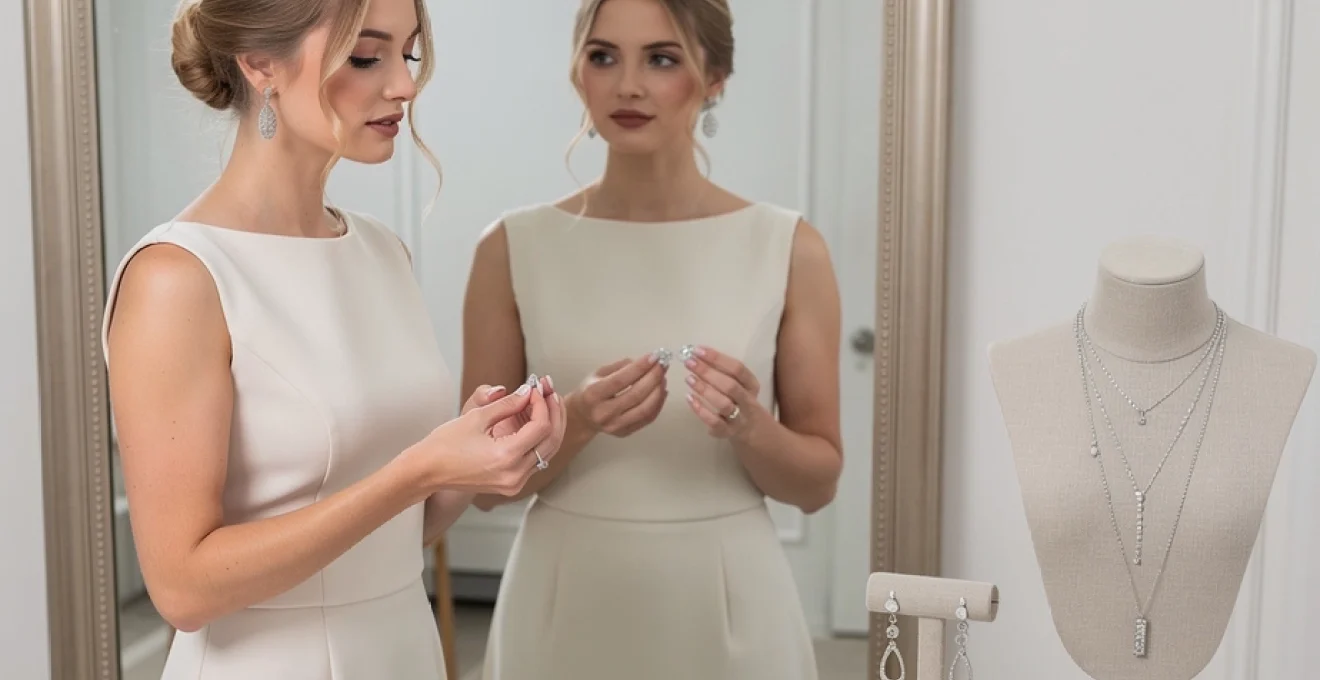
Selecting the ideal wedding jewelry requires a sophisticated understanding of proportion, balance, and aesthetic harmony. The art of creating a cohesive bridal look extends far beyond simply choosing beautiful pieces—it involves carefully orchestrating every element to complement your dress, enhance your natural features, and reflect your personal style. Modern brides face an overwhelming array of choices, from traditional pearls to contemporary gemstone combinations, each requiring thoughtful consideration of how individual pieces work together as a unified ensemble.
The key to achieving jewelry perfection lies in understanding how different elements interact with one another. Your engagement ring sets the foundation, while supporting pieces should enhance rather than compete for attention. This delicate balance becomes even more critical when considering factors such as metal coordination, gemstone placement, and the overall visual weight distribution across your bridal accessories. Mastering these principles ensures that every piece contributes to a harmonious, sophisticated appearance that photographs beautifully and feels authentically you.
Understanding wedding jewellery hierarchy and proportional balance
Creating a well-balanced bridal jewelry ensemble requires establishing a clear hierarchy among your pieces. This system ensures that each element serves its intended purpose without overwhelming the overall aesthetic. The foundation of any successful wedding jewelry selection begins with identifying your primary statement piece—typically your engagement ring—and building supporting elements around it in descending order of visual impact.
Primary statement pieces vs secondary accent elements
Your engagement ring naturally assumes the role of the primary statement piece, commanding attention through its size, sparkle, or unique design elements. This central focus point influences every subsequent jewelry choice, from the scale of your earrings to the prominence of your necklace. Secondary accent elements should complement this hierarchy by providing visual interest without competing for the spotlight. Consider how a pair of delicate pearl studs can perfectly frame your face while allowing your ring to remain the focal point, or how a simple tennis bracelet adds elegance without disrupting the established balance.
The relationship between primary and secondary pieces follows specific proportional guidelines. If your engagement ring features a substantial centre stone or elaborate setting, your supporting jewelry should adopt a more understated approach. Conversely, a minimalist engagement ring allows for slightly more dramatic accent pieces, though maintaining overall cohesion remains paramount. This balance extends beyond individual pieces to encompass the entire jewelry collection you’ll wear throughout your wedding day.
Metal weight distribution across neckline, ears, and wrists
Visual weight distribution plays a crucial role in achieving a balanced bridal look. The concept of metal weight refers not only to the physical mass of your jewelry but also to its perceived visual impact. Strategic distribution ensures that no single area appears overwhelming while maintaining proper proportional relationships across your entire ensemble. Consider how a substantial choker necklace requires corresponding earrings of appropriate scale to prevent the look from appearing top-heavy.
Professional stylists recommend following the triangle principle when distributing jewelry weight. This approach involves creating three points of interest—typically the neckline, ears, and wrists—with varying degrees of emphasis. The strongest point should align with your dress’s most prominent feature, whether that’s an intricate neckline, dramatic sleeves, or stunning back detail. The remaining two points provide supporting interest without overwhelming the primary focus area.
Scale coordination between engagement rings and wedding bands
The relationship between your engagement ring and wedding band sets the foundation for all other jewelry decisions. These pieces must work in perfect harmony, as they’ll be worn together throughout your marriage. Scale coordination involves matching not only the physical proportions but also the stylistic elements and visual weight of both rings. A delicate solitaire engagement ring pairs beautifully with a thin, understated wedding band, while a halo setting might require a band with complementary details or slightly more substantial presence.
Modern couples increasingly embrace the concept of ring stacking, which allows for creative combinations while maintaining proportional balance. This approach requires careful consideration of how multiple bands interact with your engagement ring’s silhouette. The combined visual weight should feel intentional and balanced, avoiding the appearance of overcrowding while ensuring each piece contributes meaningfully to the overall design aesthetic.
Gemstone carat weight balance in Multi-Piece ensembles
When incorporating multiple gemstones into your bridal jewelry collection, carat weight distribution becomes a critical balancing factor
When incorporating multiple gemstones into your bridal jewelry collection, carat weight distribution becomes a critical balancing factor. Think of your wedding jewellery ensemble as a visual “sound mix”: one piece can be the lead vocalist, but the others should support rather than drown it out. If your engagement ring features a sizeable diamond or coloured gemstone, opt for smaller carat weights in earrings and pendants to prevent visual overload around your face and hands. Conversely, if your ring is delicate, you can introduce slightly larger stones in your earrings or necklace without disrupting the overall proportional balance.
As a practical guideline, many stylists suggest keeping secondary gemstone pieces at roughly half to two‑thirds of the visual carat weight of your main stone. For example, a 1.5 carat centre stone pairs harmoniously with 0.25–0.50 carat total weight studs or a pendant featuring a 0.50–0.75 carat stone. This doesn’t need to be mathematically exact, but maintaining this hierarchy helps your eye move comfortably from one piece to another. Remember that cut and setting style (halo, cluster, pavé) can make a smaller stone appear larger, so always consider perceived size as much as actual carat weight.
Neckline compatibility and chain length mathematics
Neckline compatibility is one of the most important yet overlooked aspects of choosing wedding jewellery for a balanced look. Even the most exquisite necklace can feel “off” if it competes with your gown’s cut or falls at an awkward point on your décolletage. Approaching chain length almost like simple geometry—measuring, mapping, and testing where a pendant or strand will sit—ensures that your wedding necklace enhances your bridal silhouette instead of interrupting it. By aligning necklace lengths with common dress necklines, you create clean lines that photograph beautifully from every angle.
To refine this process, it helps to know your own measurements. Use a soft tape to measure from the base of your neck to the point on your chest where you’d like a pendant or pearl strand to rest. Compare this with standard chain lengths (14″, 16″, 18″, 20″, and 24″+) and factor in any additional drop from pendants or lariat designs. A difference of even 1–2 cm can determine whether a necklace sits elegantly inside a neckline or clashes awkwardly with fabric, so precision pays off when planning your wedding day jewellery.
V-neck and sweetheart neckline pearl strand calculations
V-neck and sweetheart necklines naturally draw the eye toward the centre of the chest, creating a beautiful frame for a well-proportioned pearl necklace. For these shapes, the goal is to echo the neckline’s angle without cutting across it at an unflattering point. A classic 16″ choker or 18″ princess-length strand usually sits just above or at the top of the décolletage on most body types, which works particularly well for sweetheart cuts. If your V-neck is deeper, an 18″ strand or a Y-shaped pearl pendant that drops 2–3 cm into the V can create a refined, elongating effect.
How can you “calculate” the right length? Measure from the base of your throat to the lowest point of the neckline. Aim for the bottom of your pearl strand or pendant to finish roughly 2–3 cm above this point, leaving a cushion of visible skin between jewellery and fabric. This spacing maintains proportional balance and keeps your necklace from tangling with the gown’s edge. If your dress features heavy beading or lace around the neckline, consider a finer chain with a single pearl drop rather than a full strand, so that texture and jewellery don’t compete for attention.
High collar dress earring drop length specifications
High collar and halter necklines often eliminate the need for a wedding necklace altogether, shifting the proportional focus to your earrings. Because the neck area is already visually “filled” by fabric, earrings become the primary framing element for your face. For these styles, drop length is crucial: you want enough movement to feel special, but not so much length that the earrings collide with the collar or visually shorten your neck. As a general guide, drops of 1–3 cm are ideal for high neck wedding dresses, providing elegance without overwhelming the silhouette.
If you are petite or have a shorter neck, lean toward shorter drops or structured studs with subtle dangles that sit just below the earlobe. Taller brides or those with longer necks can comfortably wear slightly longer drop earrings, sometimes up to 4 cm, especially if the collar is sleek and unembellished. Before committing, try on your chosen earrings with a garment that has a similar neckline height and photograph yourself from the front and in profile. This quick experiment reveals whether your earrings visually “float” above the collar or appear cramped, allowing you to fine-tune your choice for ideal balance.
Strapless gown choker vs opera length chain selection
Strapless gowns offer the widest range of necklace possibilities, from minimalist chokers to dramatic opera-length strands. The decision between these extremes comes down to proportion and the overall balance of your wedding jewellery. A choker (14″–15″) or short 16″ necklace emphasises the neck and collarbones, creating an elegant, slightly modern effect that pairs beautifully with structured bodices. Opera-length pieces (26″–36″), by contrast, draw the eye vertically, elongating the torso and introducing a sense of movement—particularly effective for minimalist, unembellished gowns.
To decide which is right for your balanced bridal look, consider your gown’s volume and your own height. If your skirt is full (such as a ballgown or princess silhouette), a shorter necklace often feels more harmonious, keeping visual focus near your face. If your gown is sleek and column-like, an opera-length chain, possibly doubled for a layered effect, can complement the long lines without feeling excessive. When pairing a choker with statement earrings, keep one element slightly more understated; if you choose a bold choker, select simpler earrings to prevent visual congestion around your face.
Off-shoulder design pendant positioning techniques
Off-shoulder designs highlight the collarbones and shoulders, creating a natural “frame” for a carefully positioned pendant. In this case, the challenge is avoiding a necklace that sits either too high (competing with the neckline) or too low (drawing attention away from your face). For most brides, an 18″ princess-length chain with a central pendant works beautifully, allowing the pendant to rest in the soft hollow between the collarbones. If your off-shoulder neckline is particularly low, you may extend to 20″, but ensure that the pendant still reads as part of the neckline zone rather than drifting toward the bustline.
A helpful technique is to test pendant positioning with your fitting dress or a similar off-shoulder top. Mark the ideal pendant point with a small piece of tape on your skin, then measure from the back of your neck to that point to determine your ideal chain length. Remember to factor in the extra length added by the pendant’s bail and setting, which can add 0.5–1 cm to the total drop. Balanced wedding jewellery for off-shoulder gowns often pairs this central pendant with medium-scale earrings—think classic drops or refined hoops—to keep the attention in a gentle triangle around your face, neck, and shoulders.
Metal tone coordination systems for bridal collections
Once proportion and neckline are under control, metal tone coordination becomes the next layer in building a cohesive bridal jewellery collection. While traditional advice insists on choosing a single metal, modern wedding styling embraces more nuanced systems that mix and match tones in a deliberate, structured way. The goal is to create a unified visual “temperature” so that golds, silvers, and transitional tones feel harmonious rather than haphazard. This is especially important if your engagement ring, heirloom pieces, and chosen accessories do not all share the same base metal.
To achieve a balanced look, start by identifying the dominant metal of your engagement ring and wedding band—this will anchor your overall palette. Supporting pieces can then either match this metal exactly or introduce complementary tones in controlled ratios. By thinking in terms of percentages (for example, 70% one metal, 30% another), you can safely incorporate rose gold, yellow gold, or cooler white metals without sacrificing cohesion. This structured approach allows you to honour sentimental pieces while still creating a polished, editorial-quality bridal look.
Rose gold and yellow gold mixing ratios
Rose gold and yellow gold share a warm base, making them natural partners in a mixed-metal wedding jewellery look. However, because rose gold carries a subtle pink cast, it can appear “off” if distributed randomly across your ensemble. A useful strategy is to choose one as the primary metal (often yellow gold for its classic bridal appeal) and treat rose gold as an accent, keeping it to roughly 20–40% of the total visible metal. For example, your engagement ring and wedding band might be yellow gold, while your earrings feature rose gold detailing or a two-tone design.
Think of rose gold as a soft-focus filter: a little adds romance and modernity; too much can clash with certain gown colours or skin tones. To maintain a balanced wedding jewellery aesthetic, group metals thoughtfully. You might keep all hand jewellery (rings and bracelet) in yellow gold while introducing rose gold in hair accessories or earring settings closer to your face. This separation creates defined “zones” of colour that feel intentional rather than mismatched, particularly in photographs where subtle tonal differences can become more pronounced.
Platinum and white gold temperature matching
Platinum and white gold are both cool-toned metals, often used interchangeably in bridal jewellery. Yet under strong lighting—such as professional photography or bright ceremony spaces—their subtle differences in “temperature” can become visible. Platinum tends to appear slightly greyer and more neutral, while freshly rhodium-plated white gold leans toward a brighter, almost icy white. For a perfectly balanced look, aim to keep metals within the same cool spectrum so that no single piece looks dull or overly reflective next to the others.
If your engagement ring is platinum, consider choosing wedding bands and bridal earrings in platinum or high-quality white gold with a similar finish. When mixing the two, let platinum dominate (for example, 60–80% of visible cool metal), using white gold for smaller accent pieces such as fine chains or pavé details. Before finalising purchases, compare the metals under natural daylight and warm indoor lighting, as colour shifts can occur. This simple “temperature test” ensures your cool-toned wedding jewellery reads as one cohesive family rather than a patchwork of slightly mismatched silvers.
Two-tone metal gradient techniques
Two-tone jewellery—pieces that intentionally combine different metals within the same design—offers a sophisticated solution for brides juggling multiple heirlooms or existing pieces. When used with intention, two-tone elements act like a gradient, bridging warm and cool tones across your bridal jewellery ensemble. For example, a white gold band with a fine yellow gold edge can harmonise a platinum engagement ring with yellow gold earrings, creating a visually smooth transition between disparate metals.
To keep this effect balanced, limit the number of distinct metal colours visible at any one focal point. Around your hands, for instance, you might combine a two-tone wedding band with a single-colour engagement ring, but avoid adding a third metal in a bold bracelet. Similarly, if your necklace mixes metals, choose earrings in one of those two tones rather than introducing an additional shade. By controlling where gradients occur and avoiding “colour clutter,” you maintain a refined, editorial look that still honours the complexity of your personal jewellery story.
Vintage brass and modern silver integration methods
Many brides incorporate vintage pieces—such as brass lockets, antique brooches, or family heirloom bangles—into otherwise modern silver or white gold wedding jewellery. The key to integrating these warmer, aged metals without disrupting your balanced bridal look is to treat brass as a deliberate accent rather than an afterthought. Because unplated brass has a muted, antique warmth, it pairs best with brushed or satin-finish silvers rather than highly polished, mirror-bright pieces that highlight the contrast too starkly.
One effective method is to confine brass to a single focal area, such as a hair comb, locket, or bracelet, while keeping the rest of your visible jewellery in cool-toned silver or white gold. This allows the vintage element to read as a meaningful highlight, almost like a sepia-toned photograph within a modern album. If you wish to tie the look together further, choose silver pieces with subtle yellow or champagne stones, which echo the warmth of brass without introducing more metal colours. In doing so, you preserve the sentiment of your heirlooms while maintaining a cohesive overall palette.
Gemstone colour psychology and complementary pairing
Beyond metal tones, gemstone colours play a powerful role in shaping the mood and balance of your wedding jewellery. Colour psychology suggests that different hues evoke different emotional responses: soft blues and greens feel calming and romantic, while vivid reds and pinks can feel passionate and bold. When choosing bridal gemstones, consider not only how they match your dress and flowers, but also the atmosphere you want to create in your photos and memories. A harmonious palette of two or three complementary tones usually feels more balanced than a scattered mix of many colours.
For example, blue sapphires or aquamarines can serve as both “something blue” and a cool counterpoint to warm ivory fabrics and gold settings, creating a refined, balanced contrast. Soft blush morganites or pale pink tourmalines pair beautifully with rose gold, reinforcing a romantic, modern aesthetic. If your engagement ring already features a strong coloured gemstone—such as an emerald or ruby—consider echoing that shade in smaller accents in your earrings or bracelet, but avoid repeating it at full saturation in every piece. Using lighter or darker variations of the same colour, or pairing it with neutrals like diamonds and pearls, keeps the overall effect sophisticated and cohesive.
Skin tone analysis and precious metal selection methodology
Your skin tone is one of the most reliable guides when selecting precious metals and gemstones that flatter your bridal look. While there is no rigid rule—personal preference always comes first—understanding the basic methodology of undertone analysis can help you choose wedding jewellery that makes your complexion appear brighter and more even in photographs. Typically, cool undertones (with bluish veins and a tendency to burn before tanning) respond well to platinum, white gold, and icy diamonds or blue-toned stones. Warm undertones (with greenish veins and an easier tan) often glow in yellow or rose gold, champagne diamonds, and warm-toned gems.
To assess your undertone, examine your skin in natural daylight using the vein test and by noticing whether silver or gold costume jewellery seems to “disappear” more elegantly against your skin. If both metals look equally flattering, you may have a neutral undertone, giving you wider flexibility in mixing metals. Once you identify your undertone, apply this insight to every part of your bridal ensemble: if you are cool-toned but love rose gold, for instance, consider pieces that combine white gold with rose accents, keeping the warmer metal away from areas that are heavily photographed up close, like your face and hands. This systematic approach ensures your wedding jewellery not only balances with your dress, but also enhances your natural colouring.
Seasonal wedding themes and corresponding jewellery palettes
Finally, aligning your wedding jewellery with the season of your celebration can bring an extra layer of harmony to your overall look. Seasonal palettes naturally influence everything from floral arrangements to table settings, so extending this logic to your accessories creates a deeply cohesive aesthetic. Spring weddings often lend themselves to soft pastels, fresh greens, and delicate pearl accents, mirroring the lightness of the season. Summer celebrations, with their brighter light and outdoor settings, support bolder gemstone colours and higher-contrast metal combinations that stand out in strong sun.
Autumn weddings, by contrast, are perfect for rich, saturated tones: think yellow or rose gold paired with warm gemstones such as citrine, garnet, or deep green tourmaline. These hues echo turning leaves and candlelit receptions, creating a luxurious sense of depth. Winter weddings often shine in cool, crystalline palettes—platinum or white gold, diamonds, icy sapphires, and luminous pearls—that reflect the crispness of the season. Rather than following seasonal rules rigidly, use them as a framework: ask yourself whether your jewellery palette “feels” like your chosen date and venue. When your metals, gemstones, dress, and environment all tell the same visual story, the result is a beautifully balanced bridal look that feels timeless in every photograph.