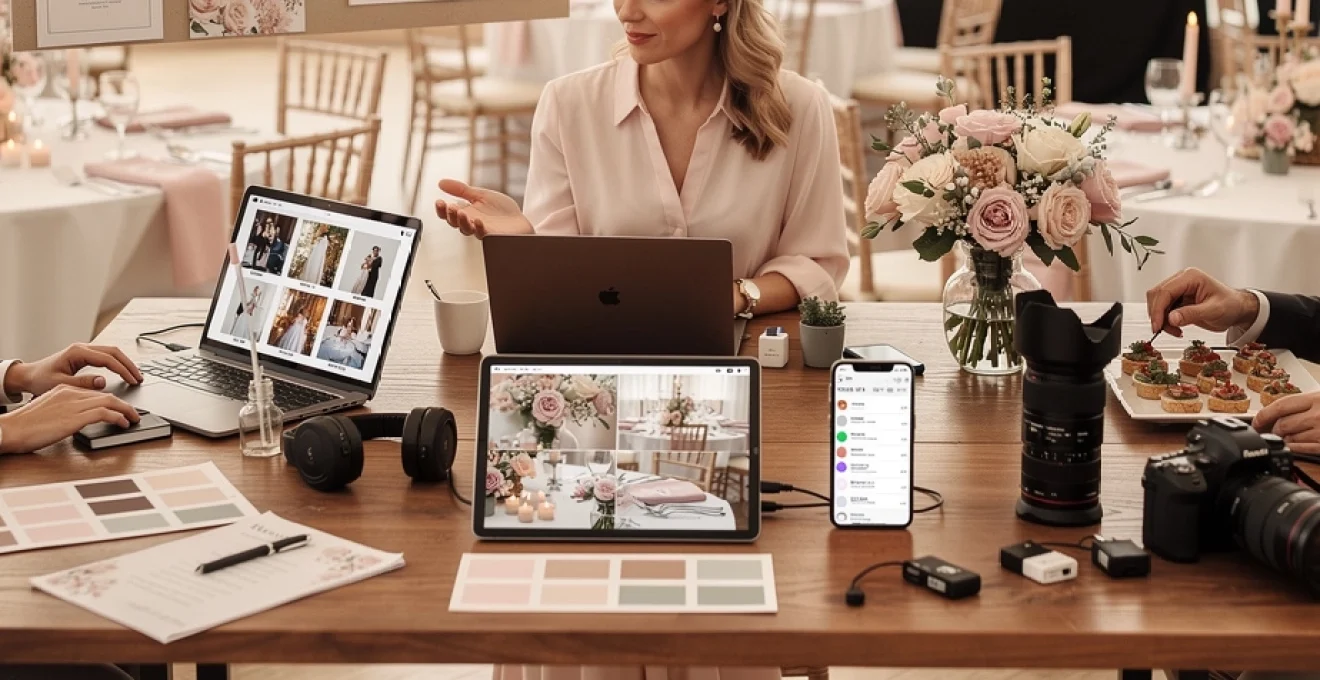
Achieving seamless coordination across multiple wedding service providers represents one of the most challenging aspects of modern wedding planning. With couples increasingly opting for bespoke celebrations that require diverse specialists—from photographers and florists to caterers and entertainment providers—maintaining consistency becomes paramount to creating a cohesive experience. The complexity multiplies when considering that each vendor brings their own working style, communication preferences, and operational standards to your special day.
Professional wedding coordination demands meticulous attention to detail and strategic planning that extends far beyond simply booking individual services. The most successful celebrations result from unified teams that operate with shared objectives, consistent brand values, and synchronized timelines. This comprehensive approach ensures that your wedding day flows seamlessly, with each service provider contributing to a harmonious whole rather than operating in isolation.
Establishing brand cohesion across Multi-Vendor wedding service teams
Creating brand cohesion across diverse wedding service providers requires establishing clear guidelines that translate your vision into actionable standards for each vendor. This process begins with developing a comprehensive brand brief that articulates not only your aesthetic preferences but also the emotional tone and experiential goals you want to achieve. Think of this document as your wedding’s master blueprint—a reference point that ensures every service provider understands their role in bringing your vision to life.
The foundation of successful brand cohesion lies in early vendor selection based on alignment with your overall aesthetic and service philosophy. When evaluating potential service providers, consider how their existing portfolio and working style complement your vision. Vendors who naturally align with your preferences will require less guidance and are more likely to deliver consistently excellent results that feel authentically integrated rather than forced.
Developing comprehensive brand guidelines for photographers, florists, and caterers
Professional brand guidelines for wedding services should encompass visual elements, service standards, and communication protocols. Your photography guidelines might specify preferred lighting styles, shot compositions, and post-processing aesthetics that align with your overall theme. Similarly, floral guidelines should detail colour palettes, arrangement styles, and seasonal preferences that complement your venue and other decorative elements.
Catering guidelines extend beyond menu preferences to encompass presentation styles, service timing, and guest interaction protocols. Consider how your caterer’s approach to food presentation aligns with your photographer’s style—elegant plated presentations photograph differently than rustic family-style service. These details might seem minor, but they contribute significantly to the overall cohesiveness of your wedding documentation and guest experience.
Creating visual identity standards using pantone colour matching systems
Implementing professional colour matching systems ensures consistency across all visual elements of your wedding. Pantone colour specifications provide precise references that translate accurately across different mediums—from printed materials and floral arrangements to lighting design and table linens. This systematic approach eliminates the ambiguity of subjective colour descriptions and ensures that your “dusty rose” appears identical whether it’s in your bouquet, invitation suite, or ambient lighting.
Distribute colour swatches and Pantone numbers to all relevant vendors early in the planning process. Your florist can use these specifications when sourcing flowers, while your stationer ensures printed materials match perfectly. Even your photographer can reference these colours when adjusting lighting setups or during post-processing to maintain accurate colour representation in your wedding images.
Implementing consistent communication protocols between service providers
Establishing standardized communication protocols prevents information gaps and ensures that updates reach all relevant parties simultaneously. Create a master communication matrix that outlines who needs to be informed about various decisions and changes. For instance, timeline modifications should reach your photographer, caterer, and entertainment provider simultaneously to prevent scheduling conflicts or service gaps.
Regular check-in meetings with key vendors help maintain alignment and address potential issues before they escalate. Schedule these meetings at strategic intervals—perhaps monthly during initial planning phases and weekly as your wedding date approaches. These sessions provide opportunities to review progress, address concerns, and ensure that all service providers remain synchronized with your evolving plans.
Establishing timeline synchronisation using project management platforms
Modern project management platforms transform wedding coordination by providing centralized timeline management that all vendors can access and update in real-time. These systems eliminate the confusion that arises from multiple versions of schedules circulating via email and ensure that everyone operates from the same authoritative timeline
. When all your suppliers can see the same live schedule, you dramatically reduce the risk of timing conflicts, rushed transitions, or long periods of guest downtime. Treat your project management platform as the single source of truth: every update, from hair and makeup delays to revised speech times, should be reflected there so that all wedding services remain fully aligned.
To maximise the effectiveness of this approach, assign clear ownership for updating the master timeline—usually your wedding planner or venue coordinator. Vendors can be granted view or edit access depending on their role, ensuring that key services such as photography, catering, and entertainment can flag conflicts early. Over time, your timeline becomes a dynamic coordination tool rather than a static document, supporting a truly seamless wedding day experience.
Digital asset management systems for wedding service coordination
As weddings become more visually driven and content-rich, effective digital asset management is essential for maintaining consistency across all wedding services. From mood boards and floor plans to photography style guides and music playlists, your digital ecosystem should support easy sharing and version control. A well-structured system ensures that every vendor works from the most up-to-date creative direction and technical information.
Think of your digital assets as the “operating system” of your wedding: when they are scattered across emails, text messages, and multiple apps, misinterpretation becomes almost inevitable. Centralising assets in dedicated tools helps you protect your vision while reducing repetitive explanations. It also allows new team members—such as an additional photographer or substitute DJ—to get up to speed quickly without compromising your established style.
Utilising cloud-based platforms like aisle planner and AllSeated for vendor collaboration
Cloud-based planning platforms such as Aisle Planner and AllSeated are designed specifically to streamline multi-vendor wedding coordination. They allow you, your planner, and your vendors to collaborate on timelines, floor plans, seating charts, and checklists in real time. Because everything lives in the cloud, changes are instantly visible to everyone with access, no matter where they are based.
AllSeated, for example, provides 2D and 3D visualisations of your venue layout, enabling your florist, rental company, and caterer to plan their setups with precision. Aisle Planner offers integrated budgeting, task management, and contact databases, helping you keep contracts, payments, and vendor details in one place. When you invite your suppliers into these platforms, you effectively create a shared digital workspace that supports a consistent guest experience across all services.
Implementing shared mood boards through pinterest business and milanote integration
Shared mood boards are one of the most powerful tools for ensuring that all wedding services interpret your vision in the same way. Platforms like Pinterest Business and Milanote allow you to curate images, colour palettes, typography, and layout inspiration in a structured, collaborative space. Rather than sending dozens of individual reference images, you can present a single, organised mood board that communicates your aesthetic at a glance.
Milanote is particularly effective for multi-vendor teams because it supports rich annotations and grouping. You can, for instance, dedicate one board to “ceremony styling” with separate columns for florals, stationery, and photography references, then tag each vendor in the sections that relate to them. Pinterest Business boards, meanwhile, can be shared via links and subdivided into sections such as “bouquets,” “tablescapes,” and “bridal portraits.” By using both inspiration and notes, you minimise guesswork and ensure that every supplier is visually aligned with your chosen wedding style.
Managing photography style guides using adobe creative cloud libraries
For couples who place high value on their wedding photography, a dedicated style guide can be invaluable. Adobe Creative Cloud Libraries allow your photographer or creative team to store shared colour profiles, presets, typography, and graphic elements that support a unified look across all visual outputs. This becomes particularly important when multiple photographers or videographers are involved, or when your wedding is captured over several days or locations.
By creating a dedicated “wedding brand” library, you can standardise everything from the warmth of your images to the treatment of black-and-white edits. Your photographer can share preview edits and receive your feedback, then apply the finalised style consistently across the entire gallery, album designs, and any same-day slideshows. The result is a coherent visual narrative where every image feels like part of the same story rather than a patchwork of different editing approaches.
Coordinating music playlists through spotify for artists and apple music for business
Music strongly shapes the emotional arc of your wedding day, so ensuring consistency between different musical moments is essential. While your DJ or band will have professional tools, platforms like Spotify and Apple Music can help you co-create playlists that reflect your shared vision. Curating “getting ready,” “ceremony,” “cocktail hour,” and “dance floor” playlists in advance gives your entertainment provider a clear understanding of your tastes and non-negotiable tracks.
For weddings using multiple music providers—such as a string quartet for the ceremony and a DJ for the evening—shared playlists help maintain a coherent style. You might, for example, use acoustic versions of your favourite songs for daytime moments, then transition to full arrangements at night. Treat your playlists as another aspect of your wedding brand: consistent genres, energy levels, and lyrical themes help create a smooth emotional journey for your guests from arrival to last dance.
Venue-specific service integration protocols
Every venue has its own operational ecosystem, and aligning your wedding services with that environment is critical to a smooth event. Venue-specific integration protocols define how external vendors interact with in-house teams, use facilities, and comply with regulations. When these protocols are clear, you avoid last-minute surprises such as power limitations for your band or restricted access times for your florist and caterer.
Begin by requesting your venue’s official vendor guidelines, including loading access, sound restrictions, preferred suppliers, and insurance requirements. Share this information with all external vendors as early as possible so they can plan accordingly. You can then create a consolidated “venue integration brief” that outlines where each service will operate, how they will move equipment, and who their on-site point of contact will be at different stages of the day.
For multi-location weddings, developing separate integration protocols for each venue (ceremony site, reception venue, after-party location) is especially important. This might include specific setup and breakdown windows, decor restrictions, and shared equipment usage. By standardising how your wedding services interface with each location, you maintain consistency in both aesthetics and guest experience, even as the physical setting changes.
Quality assurance frameworks for Multi-Service wedding packages
When multiple services work together under one wedding package—either through an agency or curated vendor team—quality assurance becomes your safeguard. A formal quality framework defines expectations for both process and outcome, from response times and professionalism to visual standards and guest feedback. Rather than relying purely on trust, you create measurable benchmarks that every supplier can understand and meet.
One effective approach is to develop a simple service-level agreement outlining key metrics such as punctuality, dress code, communication timelines, and contingency procedures. You and your planner can then review these standards with each vendor and confirm they are comfortable committing to them. During the planning phase, periodic performance check-ins—short progress reviews via email or video call—allow you to address minor issues before they impact the wedding day.
On the day itself, nominate a lead coordinator, whether that is your planner or venue manager, to observe and document any notable successes or challenges. This is not about micromanaging but about creating a feedback loop that can be used for post-event reviews, album revisions, or even future family celebrations. Treat your quality assurance framework like a safety net: ideally, you will never need to lean on it heavily, but its presence provides peace of mind that your multi-service wedding will hold together at a consistently high standard.
Client communication standardisation across wedding service providers
Consistent client communication is one of the most underrated tools for ensuring coherence between all your wedding services. When every vendor uses a different process, platform, and tone, you can quickly feel overwhelmed and disoriented. Standardising how information is collected, stored, and shared helps you maintain control and gives your suppliers a clear reference point for decision-making.
By implementing unified communication standards—such as preferred channels, response-time expectations, and document formats—you reduce the risk of critical details being lost. Think of this as building a shared language for your wedding team. Whether you are discussing menu revisions, layout changes, or playlist updates, everyone understands where to find the latest information and how to request clarification.
Developing unified client onboarding processes using CRM systems like HoneyBook
Client onboarding sets the tone for the entire planning journey. Using CRM platforms such as HoneyBook or similar systems, you can encourage vendors to follow a structured intake process that captures the same core information. This might include your wedding date, venues, colour palette, must-have moments, and non-negotiable cultural or religious elements. When all suppliers share these fundamentals, alignment becomes much easier.
Some planners invite key vendors into a centralised CRM workspace where contracts, invoices, and questionnaires are stored. Even if each supplier prefers to manage their own system, you can request that they use a standardised questionnaire template provided by your planner. This ensures that your responses are consistent and that different services—such as catering and entertainment—do not receive conflicting instructions about timing, guest numbers, or special requirements.
Creating consistent progress reporting templates for photography, catering, and entertainment
As your wedding date approaches, keeping track of progress across multiple services can feel like managing a small business project. Consistent reporting templates make it far easier to see what has been confirmed, what remains outstanding, and where you might need to make final decisions. You can create simple monthly or milestone-based reports that vendors complete and share with your planner.
For instance, your photographer’s report might confirm shot list approval, second-shooter arrangements, and delivery timelines, while your caterer’s report covers final menu selections, dietary requirements, and staffing levels. Your entertainment provider can summarise confirmed playlists, equipment needs, and cue points for key moments such as first dance and cake cutting. By viewing all these updates in the same format, you can quickly identify inconsistencies or gaps that need attention before the big day.
Establishing emergency communication protocols between venue managers and external vendors
Even the most meticulously planned wedding can encounter unexpected challenges—sudden weather changes, traffic delays, or technical issues. Emergency communication protocols ensure that when something does go wrong, your vendors respond in a coordinated, calm, and consistent manner. Rather than each supplier improvising in isolation, they follow a pre-agreed plan that prioritises guest safety and experience.
Work with your venue manager and planner to create a concise emergency contact list that includes primary and secondary contacts for each key service provider. Define how urgent messages will be shared—for example, via a dedicated WhatsApp group or radio system—and who has authority to make rapid decisions such as moving an outdoor ceremony indoors. Clarifying these roles and channels in advance means that, in the moment, everyone knows exactly what to do and who to listen to.
Post-event service delivery alignment and feedback integration
Consistency between your wedding services should continue beyond the last dance into the post-event phase. Deliverables such as photo galleries, video edits, floral preservation, and curated playlists all contribute to how you remember and share your day. Aligning timelines and standards for these outputs helps ensure that your post-wedding experience feels just as polished and cohesive as the celebration itself.
Begin by confirming delivery schedules and formats with each vendor before the wedding. For example, you might request that your photographer’s sneak peeks, your videographer’s highlight reel, and your DJ’s final playlist arrive within a similar timeframe. This coordinated approach allows you to relive your day through multiple media at once, rather than receiving everything in a disjointed sequence over many months.
Finally, implement a structured feedback process that invites you to reflect on each service and the overall coordination. Many couples find it helpful to complete a short survey or hold a debrief call with their planner to discuss what worked particularly well and what could be improved. This feedback can be shared (sensitively and constructively) with vendors and used to refine processes for future events, whether for your own anniversaries or for friends and family seeking recommendations. By closing the loop in this way, you turn your wedding into a learning experience that benefits not only you but the entire wedding service ecosystem.