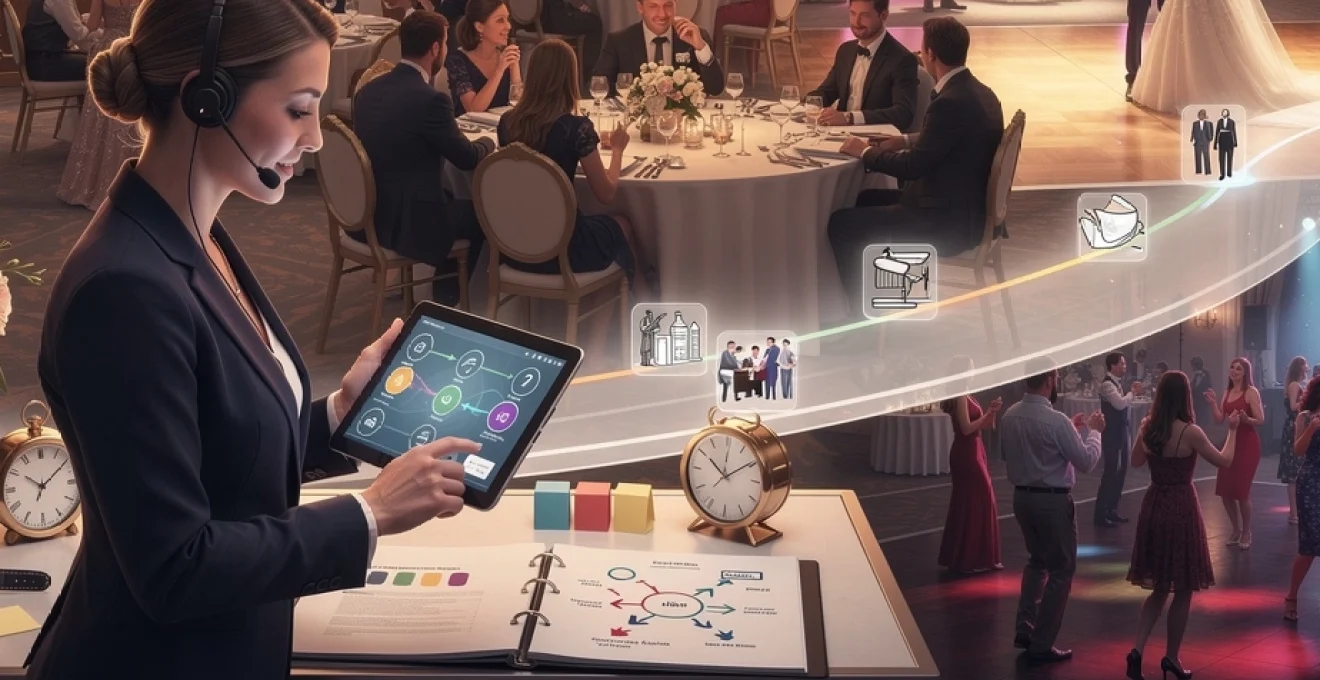
The success of a wedding reception doesn’t rest solely on the quality of the food, the beauty of the décor, or even the entertainment—it hinges significantly on how smoothly guests move from one moment to the next. The invisible architecture of transition management determines whether your celebration feels like a cohesive, emotionally resonant experience or a disjointed series of events. When transitions are executed with precision, guests remain engaged, comfortable, and emotionally connected throughout the evening. Conversely, poorly managed transitions create awkward gaps, confusion, and momentum loss that can deflate even the most meticulously planned celebration. Understanding the mechanics of transition orchestration transforms you from someone who simply schedules events to someone who crafts experiences.
Professional event coordinators recognise that the periods between formal moments—those seemingly insignificant intervals when guests relocate, wait for announcements, or shift from one activity to another—are where weddings either flourish or falter. These transitional windows require the same level of strategic planning as the headline moments themselves. The contemporary reception landscape demands more sophisticated transition management than ever before, as couples increasingly opt for multi-space venues, elaborate entrance sequences, and personalised programme structures that deviate from traditional formulas.
Pre-event timeline engineering: creating your reception flow chart
Before a single guest arrives at your reception venue, the foundation for seamless transitions must be established through comprehensive timeline engineering. This process involves creating a detailed flow chart that maps every moment of the evening with precision, accounting not just for what happens, but how guests will experience the journey from one moment to the next. The timeline serves as the master coordination document that all vendors reference throughout the evening, making it perhaps the most critical planning tool at your disposal.
Mapping critical touchpoints from cocktail hour to last dance
Begin by identifying every significant touchpoint in your reception—those moments when guest attention will be focused, redirected, or mobilised. These typically include the transition from cocktail hour to seated dinner, the grand entrance, first dance, speeches, cake cutting, bouquet toss, and final send-off. Each touchpoint represents a potential friction point where momentum can be lost if not carefully orchestrated. Map these moments chronologically, then work backwards from each to determine the preparatory steps required to execute them smoothly.
Consider that most guests will need approximately three to five minutes to physically relocate between spaces, depending on venue layout and guest count. For a reception of 150 guests transitioning from an outdoor cocktail area to an indoor dining space, factor in at least seven to ten minutes for complete guest migration. This buffer accommodates mobility variations, allows for natural conversation completion, and prevents the jarring experience of rushed movement that disrupts the celebratory atmosphere.
Coordinating vendor synchronisation points throughout the evening
Your timeline must clearly delineate synchronisation points where multiple vendors need to coordinate their activities. The transition from cocktail hour to dinner, for instance, requires coordination between the venue staff (who may be flipping the ceremony space), the catering team (preparing to serve the first course), the DJ or band (preparing entrance music), the photographer (positioning for grand entrance shots), and any decorative lighting specialists. Each vendor operates on their own internal timeline, and your master document must align these parallel workflows.
Establish specific checkpoints—typically fifteen to twenty minutes before major transitions—when your day-of coordinator confirms readiness with each vendor team. This proactive confirmation system prevents the common scenario where one vendor’s delay cascades through the entire evening. Professional coordinators often use a colour-coded system in their timelines to indicate which vendors are primary stakeholders for each transition moment, creating visual clarity that prevents oversight.
Building buffer time between ceremonial moments
One of the most common timeline engineering mistakes involves scheduling ceremonial moments back-to-back without adequate buffer time. While it might seem efficient on paper to flow directly from speeches to cake cutting to first dance, this approach fails to account for human behaviour and technical realities. Speeches invariably run longer than anticipated, equipment occasionally requires adjustment, and guests need psychological breathing room between moments of focused attention.
Strategic buffer zones of five to ten minutes between major ceremonial moments allow for natural conversation, give vendors preparation time, and prevent the reception from feeling like a rushed checklist of
reception milestones.
As you engineer these intervals, think of them as decompression chambers between high-energy or emotionally charged experiences. A five-minute transition after speeches allows guests to refresh drinks and stretch, while the band cues the next musical moment. Ten minutes between the cake cutting and opening of the dance floor gives catering time to clear plates and place dessert forks without guests feeling rushed or ignored. By intentionally inserting and protecting these buffers, you maintain control over the pacing of the wedding reception rather than reacting to delays in real time.
When in doubt, build in more time than you think you will need. Most couples underestimate how long it takes to move 100–200 people, reset spaces, or re-focus attention. Extra minutes can always be “given back” to the dance floor later, but time lost to poor planning is almost impossible to recover. Professional planners often add a hidden ten- to fifteen-minute cushion at key junctures in the wedding reception timeline, ensuring that even if something runs over, guests still experience a seamless flow.
Implementing the 15-minute rule for seamless guest movement
A practical framework many event professionals use is the “15-minute rule” for guest movement. This guideline assumes that any major shift involving most of your guests—from cocktail terrace to dining room, from dinner to sparkler exit—requires a window of up to fifteen minutes to complete comfortably. This does not mean you will always use all fifteen minutes, but it gives you a realistic ceiling that respects how people actually behave in social settings.
To apply this rule, allocate a 10–15 minute block in your wedding reception flow chart for each full-room relocation or reorientation. Within that block, define a clear starting cue (such as an announcement, music change, or lighting shift) and an endpoint (guests seated, lights dimmed, DJ ready). By treating guest movement as a formal segment rather than an afterthought, you reduce wandering, bottlenecks, and that “are we supposed to move now?” confusion. Over the course of the evening, this disciplined approach keeps transitions predictable and almost invisible to attendees.
You can also use the 15-minute rule as a stress test for your existing wedding timeline. If you find yourself stacking multiple major transitions within a half hour—say, relocating guests, doing a grand entrance, and jumping straight into first dances—you are likely compressing the evening too tightly. Adjust by shifting a ceremonial element earlier or later, or by combining moments (for instance, transitioning directly from grand entrance into the first dance) so you do not ask your guests to constantly stop and start.
Orchestrating the cocktail-to-dinner transition strategy
The shift from cocktail hour to seated dinner is one of the most critical transitions of the entire wedding reception. Guests are relaxed, conversations are flowing, and the energy is social but unfocused. Your task is to gently but firmly guide that energy into a more formal, unified experience without making people feel abruptly interrupted. Managing this transition well sets the tone for everything that follows, from your grand entrance to your first dance and speeches.
Utilising audio cues and ambient music shifts to guide guests
Sound is one of the most underused tools in wedding reception transition management. Rather than relying solely on verbal announcements, use audio cues to signal that a new phase of the evening is beginning. About ten minutes before you want guests to be seated, ask your DJ or band to shift from casual background music to slightly more defined, recognisable tracks at a slightly higher volume. This change in energy acts like a subtle “last call” for conversation.
Five minutes out, you can cue a specific transition playlist—perhaps instrumental versions of your favourite songs—that plays both in the cocktail area and the dining room. This unifies the spaces sonically and gives guests a subconscious cue to move toward the source. Then, when it is time for seating, the MC can make a concise, friendly announcement over the music, inviting guests to find their tables while the volume drops just enough to encourage movement. Think of the soundtrack of your wedding reception as a conveyor belt that gently carries people from one experience to the next.
Strategic placement of ushers and venue signage systems
Even the most elegant wedding reception can feel chaotic if guests do not know where they are going. Clear visual guidance is essential, especially in venues with multiple rooms, staircases, or outdoor pathways. Place ushers or venue staff at key junctions—doorways, hallway intersections, elevator banks—to welcome guests, answer questions, and lightly encourage movement when it is time to transition from cocktail hour to dinner.
Complement these human guides with a simple, elegant signage system. A single well-placed sign reading “Dinner & Dancing This Way” near the bar can prevent a bottleneck, while a seating chart positioned at the entrance to the reception room allows guests to orient themselves before entering. When we combine personnel and signage, we reduce the cognitive load on guests. Instead of worrying about where to go, they can stay immersed in the joy and anticipation of the celebration.
Managing the bar service migration from cocktail area to reception space
One of the most common friction points in the cocktail-to-dinner transition is bar service. If the bar abruptly closes without warning or the new bar inside the reception space is not yet ready, guests may linger in the wrong area or queue in frustration. To avoid this, plan a phased bar migration as part of your wedding reception logistics. About ten minutes before inviting guests to dinner, have staff gently mention that the bar will reopen in the main reception room shortly.
In many venues, a smart approach is to keep limited service available at the cocktail bar—a couple of staff pouring sparkling wine or water—while fully opening the main bar inside the dining room. This encourages flow in the right direction without creating a hard stop. If your venue allows it, you can also have tray-passed signature cocktails at the entrance to the reception space, drawing people inward. When guests feel they are being guided toward something rather than pulled away from it, movement becomes organic instead of forced.
Coordinating photographer positioning during guest relocation
Guest relocation is not downtime for your photographer; it is a golden opportunity for candid storytelling. As guests move from cocktail hour into the reception, your photography and videography teams should be strategically positioned to capture hugs, laughter, and the first reactions to the decorated dining room. Include these positioning notes in your wedding reception flow chart so your visual team knows where to be and when.
For example, you might have one photographer stationed near the entrance of the reception space to document guests’ first impressions, while a second floats between the hallway and dining room to capture movement and interaction. If you are planning a dramatic room reveal, ensure guests are not allowed to drift into the space early, or those magic first-look reactions will be lost. A quick coordination huddle with your photographer, planner, and venue coordinator about ten minutes before the transition keeps everyone aligned on their roles.
Mastering grand entrance choreography and introductions
The grand entrance is the pivot point where your wedding reception shifts from logistical setup to full celebration. This is where all eyes are on you and your wedding party, and the way you manage this transition will determine whether the room feels electric or uncertain. Treating the entrance like a mini production—with clear choreography, precise timing, and tight coordination between your MC, DJ, and venue team—ensures it lands with maximum impact.
Scripting MC announcements with precise timing intervals
A strong MC script is the backbone of a successful grand entrance. Rather than improvising in the moment, work with your DJ or host to write and time the announcements in advance. Start with a brief welcome that orients guests—thanking them for being there and previewing what is about to happen—then move into bridal party introductions, culminating in your own entrance as a couple. Each segment should have a clear cue and no unnecessary filler, keeping energy high and attention focused.
Build in short timing intervals of 10–15 seconds between each pair or group being introduced, allowing them to reach their destination and pose briefly without colliding with the next name on the list. Share phonetic pronunciations of all names with your MC to avoid awkward stumbles. When announcements are tight and confident, the grand entrance feels polished and intentional rather than chaotic or rushed. Think of your MC as the conductor of your wedding reception timeline; when they know the score, the orchestra follows seamlessly.
Programming lighting transitions for bridal party entrances
Lighting is to a wedding reception what stage design is to theatre: it shapes mood and focuses attention. For your grand entrance, coordinate simple but impactful lighting cues with your DJ or lighting technician. As guests are invited to take their seats, you might lower ambient lights slightly and introduce a soft wash on the dance floor or entrance doors. When the bridal party begins entering, brighter, more dynamic lighting can track their movement, building excitement.
For your own entrance as a couple, consider a distinct lighting cue—perhaps a subtle spotlight on the doorway or a warm, romantic wash over the dance floor if you are moving directly into your first dance. These transitions do not need to be complex to be effective; even a 10–15% dimming of house lights and a colour shift in uplighting can signal to guests that something special is happening. The goal is to gently pull focus toward the moment without making the room feel theatrical or overproduced.
Synchronising DJ equipment with wireless microphone handoffs
Technical hiccups are one of the fastest ways to break the spell of a grand entrance. To minimise risk, schedule a brief run-through or sound check earlier in the day focused specifically on the entrance sequence. Confirm that your DJ’s music cues are correctly ordered and that wireless microphones are tested, fully charged, and set to appropriate volume levels. Decide in advance who will physically hold and hand off the microphone—the DJ, the MC, or the planner—so there are no awkward scrambles on the dance floor.
If your entrance flows directly into first dance or welcome speeches, ensure transitions between tracks are seamless and that microphones are available where they will be needed next. For example, if a parent is giving a brief welcome, have them seated near the front and cue them before you enter so they are ready. When music, microphones, and movement are synchronised, the entire opening sequence of your wedding reception feels like one smooth, intentional arc.
First dance to speeches: managing emotional momentum shifts
The sequence from first dance into speeches is one of the most delicate emotional transitions of the wedding reception. You are moving guests from a highly intimate, visually focused moment into more verbal, narrative-driven content. If handled well, this shift deepens the emotional connection in the room; if mishandled, it can feel jarring or cause attention to drift.
One effective strategy is to maintain continuity by keeping you, as the couple, in a central, visible position during the transition. For example, after your first dance ends, the MC can invite parents or the best man and maid of honour to join you on the dance floor or at your table, rather than having you disappear into the crowd. The DJ gently lowers the music, a spotlight softens, and the first speech begins while the emotional resonance of the dance is still present.
Timing matters here as well. Statistics from leading wedding planning platforms indicate that guest attention is highest during the first 90 minutes of the reception. Positioning key speeches within this window—ideally just after first dance and before the main course—is a smart use of that attention. Keep individual speeches to three to five minutes where possible, and brief speakers ahead of time about tone, content, and timing. This is not about restricting emotion; it is about protecting the emotional pacing of your entire evening.
Dinner service coordination with entertainment interludes
Dinner is often the longest continuous block of time in your wedding reception, and without careful planning it can feel like a lull. The key is to weave light-touch entertainment and formalities between courses, using the natural rhythm of service to your advantage. When you coordinate catering, speeches, and visual elements, dinner becomes a dynamic experience rather than a pause in the celebration.
Timing speeches between course service windows
For a plated meal, the ideal moments for speeches are between courses, not during active service. Aim to schedule toasts after the first course has been cleared and again once the main course has largely been served and guests have had time to eat. This timing minimises background noise from clinking plates and moving staff, ensuring speakers can be heard and guests are not distracted by hot food arriving mid-sentence.
Share a detailed wedding reception timeline with both your caterer and your MC, highlighting when each speech block is planned. Build in a five-minute buffer on either side of each speech segment to account for slight delays in the kitchen or unexpected emotional moments at the microphone. When service and speeches are coordinated as parts of the same choreography, the evening feels smooth and considered rather than stop–start.
Implementing silent auction or photo slideshow during main course
During the main course, you generally want to avoid major formalities so guests can enjoy their meal and conversation. However, this does not mean the room should feel static. Low-interruption engagement tools like a silent auction (for charity-focused weddings) or a curated photo slideshow can add depth without demanding full attention. Think of these as background layers that enrich the atmosphere rather than centre-stage performances.
A photo slideshow of your relationship, displayed on screens around the room or projected discreetly, gives guests talking points and allows them to connect more deeply with your story. If you are incorporating a silent auction, ensure bidding can be done via mobile devices or at clearly marked stations, with end times that do not conflict with later key moments like cake cutting. These understated interludes maintain interest and energy without competing with dining.
Coordinating catering staff clearance before cake cutting ceremony
The transition from dinner to cake cutting is another point where logistics and ceremony intersect. Visually, you want the focus on the cake and on you as a couple; practically, you need cleared tables and minimal staff movement in the background. Plan for a short clearance window—typically 10–15 minutes—between the end of the main course and the start of the cake cutting.
During this time, the DJ can play slightly more upbeat music to signal that the evening is shifting gears, while catering staff quietly clear plates and reset any necessary table elements. Your planner or venue coordinator should confirm with the catering captain when clearance is 90% complete before cueing the DJ or MC to announce the cake cutting. By aligning these timelines, you avoid the common scenario of servers darting behind you in photos while you are cutting the cake.
Managing toastmaster handovers with banqueting team leaders
On paper, the roles of toastmaster or MC and banqueting team leader seem distinct; in reality, their collaboration is essential to smooth transitions. Every time the microphone is picked up, service should pause or quieten; every time plates are being cleared or courses served, formal speaking should pause. A brief pre-event meeting between these two roles can prevent dozens of small but disruptive overlaps.
Agree on simple handover signals—eye contact, a subtle nod, or a raised hand—so that neither side feels surprised by the other’s timing. Include these cues in your wedding reception production notes so all vendors understand that speeches, announcements, and service are interdependent. When your verbal programme and banqueting operations move in lockstep, guests experience an effortlessly orchestrated evening rather than a tug-of-war between food and formalities.
Activating the dance floor: post-formalities energy escalation techniques
Once formalities are complete—cake cut, final speeches done—the wedding reception shifts into its purest celebration phase. The challenge now is to convert seated, conversational energy into a lively, sustained dance floor without losing guests to the bar or terrace. This is where thoughtful programming, well-timed traditions, and deliberate sequencing of music and movement come together.
Programming DJ set progression from first dance to open floor
A strong dance floor does not happen by accident; it is the result of deliberate set progression. Work with your DJ to design a three-part arc: romantic and mid-tempo tracks immediately following your first dance to draw couples and close friends to the floor, followed by a high-energy block of universally recognisable hits to fill it, then more niche or era-specific favourites later in the evening.
Consider transitioning directly from your first dance into an “all couples” or “join us” track rather than clearing the floor. This avoids a dead space and gives shy guests permission to step in. From there, your DJ can gradually increase tempo and intensity, reading the room in real time. Provide a short “must play” and “do not play” list, but trust your DJ’s expertise in building momentum; they see which songs keep feet moving and which send people back to their seats.
Strategic timing of bouquet toss and garter removal traditions
If you are including traditions like the bouquet toss or garter removal, their placement in the wedding reception timeline can either boost or break dance floor energy. A smart approach is to schedule them 60–90 minutes into open dancing, once the floor is established but before older or more fatigue-prone guests begin to depart. This creates a natural mid-evening “spike” of attention that refreshes the room.
Keep the interruption brief and focused. The DJ announces the toss, plays one high-energy track to gather participants, executes the moment, and then immediately drops a crowd-pleaser to pull everyone back onto the floor. Treat these traditions like punctuation marks rather than full stops—fun, noticeable beats that accent the sentence of your wedding reception rather than halt it.
Implementing the parent dance sequence without momentum loss
Parent dances are some of the most emotional and meaningful moments of the evening, but if placed poorly they can drain the dance floor. One effective strategy is to schedule them near the start of dancing, directly after your first dance or shortly after cake cutting, when guests are still attentive and present. You might move from first dance into a father–daughter dance, then a mother–son dance, with each track kept to a comfortable length of two to three minutes.
To prevent momentum loss, ask your DJ to segue from the final parent dance into an upbeat, multi-generational favourite—something that encourages both older relatives and younger friends to join you. You can even invite all parents and children to the floor for the second half of a parent dance song, symbolically widening the moment and populating the dance floor in one move. When these deeply personal dances are integrated into the wider flow of the wedding reception rather than isolated, they enhance connection without sacrificing energy.