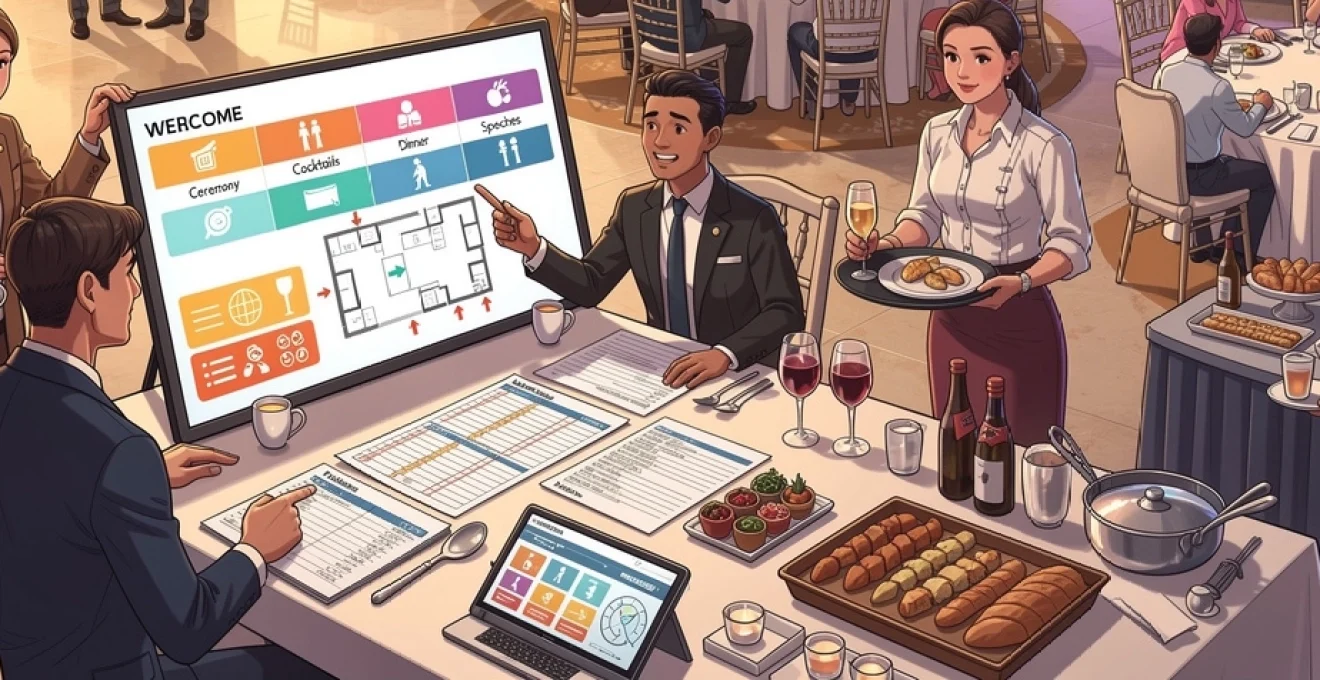
A wedding reception that flows seamlessly from moment to moment creates an experience your guests will remember fondly for years to come. When transitions feel natural, speeches arrive at just the right moment, and the energy builds organically throughout the evening, you’ve achieved something truly special. The difference between a reception that feels effortless and one that seems disjointed often comes down to meticulous planning, strategic timing, and thoughtful spatial design. Creating this fluid experience requires understanding how guests move through space, how programme elements interact with one another, and how to build momentum that carries everyone from the first toast through to the final dance. The architecture of a successful reception isn’t left to chance—it’s carefully constructed through deliberate decisions about timing, placement, and sequencing.
Pre-event timeline architecture and guest journey mapping
The foundation of any naturally flowing reception begins long before your first guest arrives. Proper timeline architecture serves as the invisible framework that supports every aspect of your celebration, ensuring that each moment transitions smoothly into the next without awkward pauses or rushed segments.
Creating a Minute-by-Minute reception flow chart
Developing a comprehensive flow chart requires you to visualize your entire reception as a continuous experience rather than isolated events. Begin by establishing your fixed points—venue access times, catering service windows, and vendor setup requirements. Between these anchors, you’ll plot every significant moment, from the grand entrance to the final farewell. A detailed flow chart should account for approximately 90-95% of your reception time, leaving small buffers for spontaneity and unexpected delays. Consider creating a visual timeline that colour-codes different activity types: blue for guest-focused moments, green for dining service, yellow for entertainment segments, and red for critical transitions. This visual representation helps you identify potential bottlenecks where too many activities cluster together or gaps where energy might lag.
Calculating optimal transition intervals between programme segments
The space between events—those seemingly empty moments—actually carries significant weight in maintaining your reception’s rhythm. Research suggests that guests need approximately 3-5 minutes to mentally shift between different types of activities. After an emotional speech, allowing a brief musical interlude before the next toast gives guests time to compose themselves and refocus their attention. Similarly, the transition from ceremony to cocktail reception typically requires 15-20 minutes for guests to relocate, visit facilities, and settle into the new space. When calculating these intervals, factor in the physical distance guests must travel, the complexity of the upcoming activity, and the emotional shift required. A transition from dinner to dancing might need only 8-10 minutes with proper musical cueing, whilst the shift from formal programme to open dancing often benefits from a 12-15 minute buffer that includes cake cutting and a few announcements.
Strategic guest arrival window management and welcome protocol
Managing the initial arrival period sets the tone for everything that follows. Rather than designating a single arrival time, consider implementing a structured arrival window of 20-30 minutes with staggered instructions for different guest groups. Family members might receive invitations stating 6:00 PM, whilst other guests are invited for 6:15 PM, naturally distributing arrival traffic. Your welcome protocol should include designated greeters positioned at key entry points, clear directional signage visible from the car park, and immediate engagement activities such as a welcome drink station or guest book area. The most effective arrival sequences create a sense of progressive discovery, where guests encounter thoughtfully placed elements—perhaps a signature cocktail display, followed by escort card arrangements, then the ceremony or reception entrance—that naturally guide them through the space whilst managing crowd density.
Coordinating vendor delivery schedules with event milestones
Behind every seamlessly executed reception lies a complex choreography of vendor arrivals, setups, and service moments. Your florist might need access four hours before guest arrival, whilst your caterer requires entry six hours in advance for kitchen setup. Creating a vendor timeline that maps these needs against your event milestones prevents conflicts and ensures readiness. For instance, schedule your photographer’s arrival to capture final décor details after florists complete their work but before hair and makeup artists occupy key spaces. Coordinate band or DJ setup during cocktail hour when guests occupy a different area, preventing disruptive noise during ceremony moments. A comprehensive vendor schedule should indicate not just arrival times but also critical handoff
points, such as when the room flip must be complete, when candles should be lit, or when the cake needs to be on display. Share this document with all suppliers at least one week prior and review it in a brief coordination call. By orchestrating these logistics in advance, you reduce the likelihood of last-minute delays that can break the natural flow of your reception.
Spatial planning and traffic flow optimisation for seamless movement
Even the most meticulously timed reception can feel disjointed if the physical layout of your venue works against you. Spatial planning is about designing how people move, pause, and gather across the different phases of the event. When you think of your reception as a series of “stations” along a guest journey, it becomes easier to anticipate where congestion might occur and how to keep people moving comfortably. Well-considered traffic flow ensures that guests never feel lost, crowded, or stuck waiting in long lines.
Designing clear pathways between ceremony, cocktail, and dining zones
Clarity and simplicity are the guiding principles when creating pathways between key zones. Guests should be able to intuitively find their way from the ceremony to cocktail hour and then to the dining and dancing spaces without constant verbal direction. Position visual anchors—such as floral installations, lighting features, or statement décor—along the main route to subconsciously draw guests forward. If your ceremony and reception are in different locations, provide a clearly mapped route on your programme or wedding website and consider shuttle transport for larger groups.
Think of your venue as a series of “neighbourhoods” connected by well-marked streets. Avoid narrow pinch points, such as a single small doorway that every guest must pass through at once, by opening alternative routes where possible. Keep high-traffic elements like gift tables, escort cards, and guest books slightly off the main pathway so guests can step aside to engage with them without blocking movement. For outdoor weddings, use lighting, lanterns, or aisle runners to define paths after sunset and prevent guests from wandering unintentionally into service areas.
Strategic placement of service stations and refreshment points
Service stations act as magnets, drawing people to specific areas and naturally shaping how crowds form. To maintain a reception that flows naturally, place bars, food stations, and dessert tables in locations that encourage circulation rather than clustering. A single bar directly next to the entrance, for example, almost guarantees an initial bottleneck. Instead, consider two smaller bars at opposite ends of the space or a main bar supplemented by roaming servers with trays of drinks.
Similarly, buffet stations and grazing tables work best when accessible from multiple sides, allowing guests to serve themselves without forming a single long line. Dessert and coffee stations can be positioned closer to the dance floor to entice guests back into the main activity area after the meal. When planning your reception layout, ask yourself: if 50 people head to the bar at once, where will they naturally queue, and how will that affect others trying to navigate the room? Adjust placements until the answers support free, comfortable movement.
Queue prevention tactics for bar, buffet, and facilities access
Nothing disrupts the feeling of an effortless event like standing in a slow-moving queue. Preventing long lines requires a mix of smart layout, realistic staffing, and intentional scheduling. Industry benchmarks suggest one bartender for every 50–75 guests for standard service, or one for every 40–50 guests if you anticipate complex cocktails. During peak times—immediately after the ceremony or right as dinner ends—briefly increasing staff behind the bar can dramatically reduce perceived wait times.
For buffet or family-style service, stagger table releases instead of inviting the entire room to serve themselves at once. Your MC or DJ can invite two or three tables at a time, starting from different points in the room to avoid a single line forming. Restroom queues can be managed by ensuring adequate facility numbers for your guest count and, when necessary, adding luxury restroom trailers for outdoor receptions. Observe where queues are likely to form during your walk-through and build in small “holding zones” with décor or conversation areas so guests never feel like they are simply standing in line.
Implementing directional signage and visual wayfinding systems
Clear, attractive signage is one of the simplest ways to support a smooth guest journey. Think beyond a single welcome sign and consider a cohesive wayfinding system that guides guests from parking to ceremony, then to cocktails, dinner, and dancing. Use consistent fonts, colours, and iconography so signs are easy to recognise at a glance. Arrows, pictograms, and short, direct wording (“To the Bar,” “Restrooms,” “Ceremony This Way”) reduce confusion and minimise the number of times guests need to ask for directions.
Visual wayfinding doesn’t stop at printed signs. Lighting, draping, floral markers, and even floor decals can subtly indicate where guests should go next. For example, a string of lanterns leading from the cocktail garden to the barn, or a path of candles from the dining tent to the dance floor, creates a natural flow without a single spoken instruction. Effective signage and visual cues work like stage directions in a theatre production: most guests never consciously notice them, but they’re essential to ensuring everyone ends up in the right place at the right time.
Strategic programme sequencing and transition choreography
The order of events during your reception has a powerful impact on how the evening feels. Thoughtful programme sequencing ensures that emotional, logistical, and energy-intensive moments are balanced in a way that feels natural. Instead of viewing your reception as a checklist—first dance, speeches, cake cutting—consider it as a storyline with a beginning, build-up, peak, and gentle close. Every element should have a reason for its placement, both in terms of practicality and guest experience.
Many couples now favour a “front-loaded” structure where key formalities happen earlier, leaving more unstructured dance time later in the night. For instance, you might plan a grand entrance directly into your first dance, followed by a brief welcome toast and then dinner. Speeches can be split between courses to maintain attention and prevent fatigue, with the cake cutting serving as a natural bridge from dinner to dancing. Think of transitions like editing in a film: smooth cuts, crossfades, and well-timed musical cues keep the narrative moving without jarring jumps.
Choreographing transitions means deciding who will cue what and when. Will your DJ invite guests to find their seats for speeches? Will your planner tap the photographer before the bouquet toss so they’re in position? Assign clear responsibilities for each transition so no one is left guessing. Music is one of your most effective tools here: a shift from background jazz to a more upbeat track can signal that it’s time to move to the next phase without a single announcement.
Culinary service timing and course progression strategy
Your catering timeline is one of the most influential factors in how naturally your reception flows. When courses are well-timed, service feels almost invisible, allowing conversation and connection to take centre stage. When service lags or arrives at awkward moments, it can interrupt speeches, dilute emotional beats, and leave guests either hungry or rushed. Building a clear course progression strategy with your caterer ensures that food supports the overall rhythm of the evening rather than competing with it.
Synchronising plated service execution with toast and speech intervals
For plated dinners, synchronisation between the kitchen, service team, and MC is essential. Guests should never be trying to cut into a steak while also listening to a heartfelt parent speech. A widely used approach is to schedule major speeches either between courses or once the main course plates have been cleared. For example, you might serve starters, allow 20–25 minutes for eating and conversation, then have two short toasts before the main arrives. Another option is to save longer speeches for after the main course, when guests are satisfied but not yet ready to move to dessert.
A useful analogy is to think of the meal as a soundtrack and the speeches as the lyrics—you want them to complement one another, not compete for attention. Share your detailed reception flow chart with your caterer so they can plan cooking and plating times around speaking intervals. Ask them how long they need between the “go” signal and plates hitting the table for each course. Build in a small buffer (5–10 minutes) before and after key speeches in case earlier service runs slightly ahead or behind schedule. This coordination allows the night to feel polished without feeling rigid.
Buffet replenishment scheduling to maintain continuous availability
For buffets or food stations, your main enemy is the “empty tray” moment, which immediately signals disorganisation and can make guests feel they’ve missed out. Prevent this by working with your caterer to set explicit replenishment checkpoints based on guest count and menu items. High-demand dishes—popular mains, vegetarian options, and signature sides—should have backup pans ready to swap in quickly. Allocate at least one staff member whose primary role during service is monitoring levels and refreshing items before they run out.
Staggering guest access to the buffet also supports both food quality and reception flow. Rather than opening the buffet to the entire room simultaneously, release guests table by table in intervals of a few minutes. This keeps lines shorter and allows the kitchen to maintain an attractive, abundant presentation. Treat the buffet like a well-orchestrated airport security line: multiple entry points, clear direction, and constant movement are key to avoiding bottlenecks. Signage indicating “Start Here” and “Plates This Way” can further streamline the process.
Beverage service cadence from welcome drinks through dessert
Beverage service sets the social temperature of your reception from the moment guests arrive. A well-planned cadence—from welcome drinks to wine with dinner and late-night options—helps maintain energy without overwhelming the bar or your budget. Start with readily available welcome drinks or a signature cocktail during arrival to reduce initial bar congestion and give guests something to enjoy immediately. During dinner, table service of wine and water keeps guests seated and engaged, whilst a scaled-back bar menu can speed up service and prevent long queues.
After dessert, consider re-introducing a broader bar selection, along with coffee and tea stations to support those planning to dance late into the night. Late-night snacks pair well with a shift to simpler drinks such as beer, wine, and a limited cocktail menu, which are faster to prepare. Think of your beverage service as a series of “chapters” that align with your overall wedding reception timeline: arrival, dining, dancing, and farewell. Coordinating these phases with your bar team and DJ helps ensure peaks in demand are anticipated rather than surprising.
Entertainment programming and energy management throughout the event
Entertainment is one of the most visible drivers of how your reception feels, yet it’s also one of the easiest elements to mis-time. Rather than treating music, performances, and interactive elements as isolated highlights, integrate them into an overarching energy management strategy. Ask yourself: when do we want guests to feel relaxed and conversational, and when do we want them on their feet and fully engaged? Mapping entertainment to these desired energy levels keeps your reception flowing naturally from calm to celebratory and finally to a satisfying close.
Think of your wedding reception like a live concert with carefully curated opening acts, a main performance, and an encore. Softer background music during cocktails and the first half of dinner encourages conversation and connection. As you transition into speeches, your DJ or band can lower the volume and adjust the playlist to match the tone of each moment. Once formalities wrap, a clear musical shift—often led by your first dance, followed by energetic crowd favourites—signals the start of the party. Strategically placing interactive elements like a photo booth, lawn games, or cultural dances helps sustain engagement without overwhelming guests.
Pacing is essential to prevent energy crashes. Too many back-to-back high-intensity moments can leave guests fatigued; too many slow songs in a row can empty the dance floor. Encourage your DJ or band to read the room and adapt, balancing familiar hits with a few personal favourites that reflect your story as a couple. Schedule any optional traditions—such as bouquet tosses or anniversary dances—during natural lulls to recapture attention. The aim is to create a gentle wave of energy that rises, dips just enough for people to rest, and then builds again toward a memorable finale.
Contingency planning and real-time flow adjustment protocols
No matter how carefully you plan, real events rarely follow a script perfectly. Weather shifts, speeches run long, traffic delays key guests—any of these can disrupt your ideal reception timeline. Contingency planning is your safety net, allowing your celebration to adapt gracefully rather than descend into chaos. Start by identifying your non-negotiable moments (perhaps your first dance, a cultural ceremony, or sunset portraits) and then decide which elements can be shortened, combined, or even skipped if necessary.
Create an “A-plan” and a streamlined “B-plan” for major components like outdoor ceremonies, room flips, and photography sessions. For example, if rain threatens your garden cocktail hour, your B-plan might move drinks under a tent or indoors, with an adjusted layout that still supports easy flow. Build time buffers of 5–15 minutes at key transition points, especially around guest arrivals and vendor changeovers. Think of these buffers as shock absorbers in a car suspension: most of the time you hardly notice them, but they protect your overall journey when you hit unexpected bumps.
Real-time adjustment protocols focus on who has the authority to make changes and how those changes are communicated. Designate a single point of contact—usually your planner or venue coordinator—to monitor the clock, assess how the reception is unfolding, and make on-the-spot decisions. Provide that person with a hierarchy of priorities so they know whether to shorten the cocktail hour to protect dance time, or to push speeches slightly later to accommodate delayed guests. Ensure your MC, DJ, caterer, and photographer receive any timeline updates quickly so they can adjust their cues, service, and coverage without visible disruption.
Ultimately, a reception that flows naturally from start to finish is less about perfection and more about responsiveness. When your team understands both the ideal plan and the acceptable alternatives, they can adapt in ways that guests barely notice. By combining a solid timeline, thoughtful spatial design, intentional sequencing, and robust contingency plans, you create a framework that allows the evening to feel effortless, even when you know how much planning went on behind the scenes. This is the quiet art of a truly seamless wedding reception.