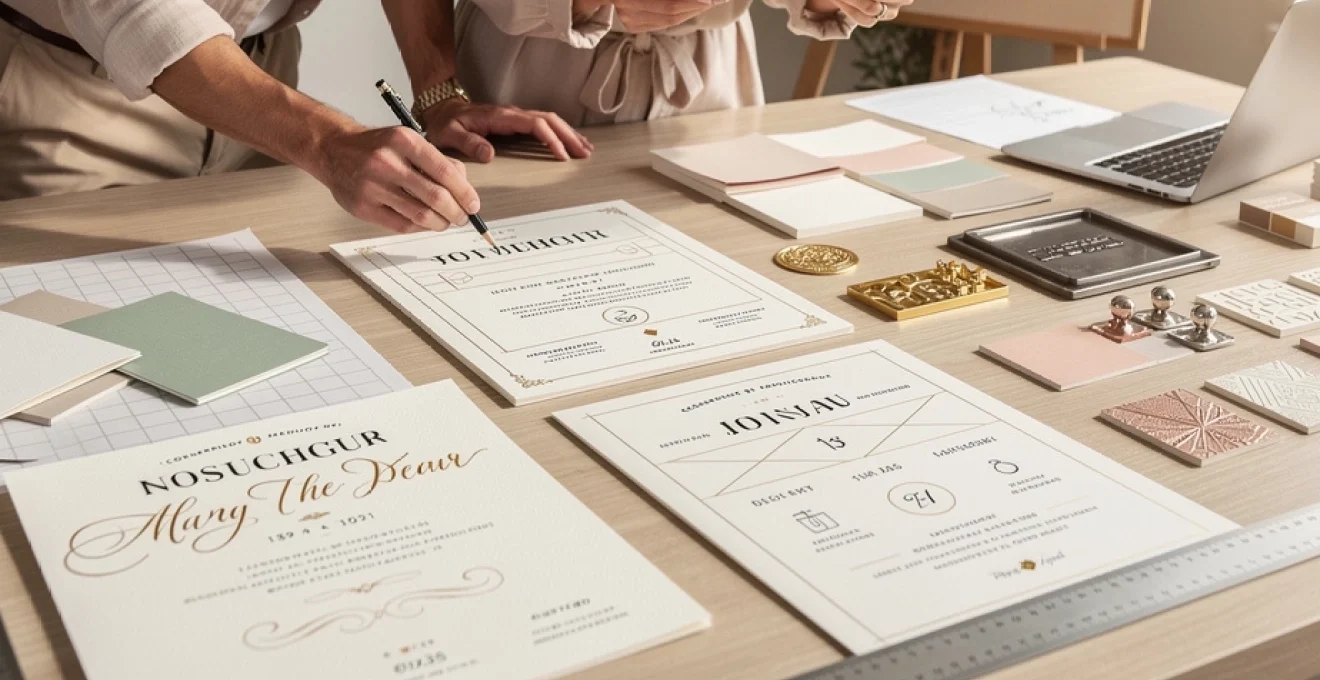
The wedding announcement serves as the first glimpse into your special day, setting expectations and creating anticipation amongst your loved ones. A thoughtfully designed announcement goes beyond mere information delivery—it becomes a keepsake that captures the essence of your celebration whilst demonstrating the care and attention you’ve invested in every detail. Modern couples face an overwhelming array of design choices, from traditional elegance to contemporary minimalism, each requiring careful consideration of typography, materials, and visual hierarchy to achieve maximum impact.
Professional wedding announcements distinguish themselves through meticulous attention to design fundamentals, premium materials, and strategic content placement. The difference between a forgettable announcement and one that guests treasure lies in understanding how visual elements work together to create emotional resonance. Whether you’re planning an intimate gathering or a grand celebration, your announcement design should reflect your personality whilst maintaining the sophistication expected of such an important milestone.
Typography selection and hierarchy for wedding announcement design
Typography forms the backbone of exceptional wedding announcement design, influencing both readability and emotional impact. The strategic selection of fonts creates visual hierarchy whilst conveying the tone and formality level of your celebration. Professional designers understand that typography choices can make the difference between an announcement that feels rushed and one that exudes careful consideration and refinement.
Serif font combinations: times new roman and garamond pairings
Classic serif fonts like Times New Roman and Garamond offer timeless elegance that works beautifully for traditional wedding announcements. These typefaces possess inherent sophistication and excellent readability across various print sizes. When pairing serif fonts, consider using Garamond for body text due to its superior legibility at smaller sizes, whilst Times New Roman works exceptionally well for headlines and couples’ names. The slight contrast in character weight between these fonts creates subtle visual interest without compromising coherence.
Professional designers often recommend maintaining a maximum of two serif fonts within a single announcement to avoid visual confusion. The key lies in selecting fonts that complement rather than compete with each other. Garamond’s refined elegance pairs beautifully with Times New Roman’s authoritative presence, creating a hierarchy that guides readers’ eyes naturally through the information. Consider how these fonts will appear when printed on your chosen paper stock, as certain textures can affect character clarity and overall visual impact.
Script typography integration: calligraphy and Hand-Lettered elements
Script fonts and calligraphy elements add personalisation and romantic appeal to wedding announcements, but require careful integration to maintain professionalism. Hand-lettered elements work particularly well for couples’ names or special phrases, creating focal points that draw attention whilst adding character. However, overuse of script fonts can compromise readability and create visual chaos, particularly when combined with multiple other typefaces.
The most effective approach involves using script elements sparingly for emphasis rather than entire text blocks. Consider employing professional calligraphy for the couples’ names whilst maintaining serif or sans-serif fonts for essential information like dates, times, and venues. This balance ensures your announcement remains both beautiful and functional, allowing guests to quickly locate important details whilst appreciating the decorative elements that reflect your personal style.
Font size ratios and white space management techniques
Establishing appropriate font size ratios creates visual hierarchy that guides readers through your announcement logically. Professional designers typically employ a scaling system where the largest text (couples’ names) measures approximately 24-36 points, whilst body text ranges from 10-14 points. This creates sufficient contrast to establish clear information hierarchy without overwhelming the design with extreme size variations.
White space management proves equally crucial in creating sophisticated wedding announcements. Strategic use of negative space around text elements prevents crowding and enhances readability. Professional designers recommend maintaining at least 1.5 times the x-height of your chosen font as line spacing, whilst allowing generous margins to frame the content elegantly. This approach creates breathing room that elevates the overall design quality and demonstrates attention to professional printing standards.
Readability standards for print and digital distribution
Modern wedding announcements often require optimisation for both print and digital distribution, necessitating careful consideration of readability across different mediums. Print announcements benefit from higher contrast ratios and slightly larger font sizes to accommodate various lighting conditions and viewing distances. Digital versions require different considerations, including
screen resolution, zoom levels, and device variability. For digital wedding announcements, aim for a minimum of 14–16 points for body copy on screens, and test legibility on both mobile and desktop devices. Maintain sufficient colour contrast between text and background (at least a 4.5:1 ratio) to ensure accessibility for all guests, including those with visual impairments.
When designing a wedding announcement intended for email or your wedding website, avoid overly thin scripts or ultra-light weights that can break up on lower-resolution displays. Instead, reserve these delicate styles for headings or decorative accents and support them with robust serif or sans-serif fonts for essential information. Always perform a print proof and a digital test before final approval to confirm that line spacing, font sizing, and contrast perform well in real-world conditions.
Premium paper stock selection and printing specifications
The tactile quality of your wedding announcement is just as important as its visual design. Paper choice, printing method, and finishing techniques all contribute to how luxurious and memorable your stationery feels in hand. When you combine thoughtful typography with premium paper stock and professional printing, your wedding announcement transforms from a simple card into a keepsake that guests are likely to treasure for years.
Paper weight, texture, and colour should complement your overall wedding aesthetic and support legibility. Heavier stocks (typically 300–600 gsm) convey formality and durability, while subtle textures like cotton or eggshell add depth without distracting from your typography. As you evaluate options, request printed samples wherever possible so you can compare how different papers handle ink density, foil stamping, and impression depth from letterpress or embossing.
Cotton rag papers: crane & co and mohawk fine papers options
Cotton rag papers from brands such as Crane & Co. and Mohawk Fine Papers are widely regarded as the gold standard for luxury wedding announcements. Made from 100% cotton or high cotton content blends, these papers offer a soft yet substantial feel with excellent archival qualities. Cotton fibres absorb ink beautifully, resulting in crisp letterforms and rich colour saturation, which is essential when you want your typography and motifs to appear refined and intentional.
Crane & Co. is known for its smooth, pillowy surfaces that work particularly well with letterpress and engraving, while Mohawk Fine Papers offers a broader spectrum of textures and shades, from bright white to warm ivory. When designing your wedding announcement, consider how the paper shade interacts with your chosen ink colours; cool whites flatter modern palettes with greys and blues, whereas creamy ivories pair beautifully with classic gold or sepia tones. Both brands typically provide swatch books and sample packs, making it easier for you to compare thicknesses and finishes before committing.
Letterpress vs digital printing: cost-benefit analysis
Choosing between letterpress and digital printing for your wedding announcement often comes down to budget, timeline, and the level of tactile luxury you desire. Letterpress printing uses metal or polymer plates to press inked text and artwork into the paper, creating a distinct debossed impression that feels luxurious and artisanal. This method is ideal for minimalist designs where texture, typography, and white space do most of the visual work. However, setup costs for plates and manual press time mean letterpress is typically most cost-effective for mid to large print runs.
Digital printing, by contrast, offers high flexibility at a lower price point, particularly for smaller quantities or multi-colour artwork with gradients and photographs. Modern digital presses produce sharp text and accurate colour, making them suitable for many contemporary wedding announcement designs. If your budget is limited, you might choose digital printing for the main cards while allocating funds to premium touches such as thicker cardstock or specialty envelopes. A hybrid approach—digital printing with spot foil or an embossed monogram—can deliver a high-end look without a fully letterpressed suite.
Foil stamping techniques: gold leaf and rose gold applications
Foil stamping adds a reflective metallic or pigmented finish to selected areas of your wedding announcement, instantly elevating its perceived value. Gold leaf and rose gold foils are particularly popular choices, as they complement both traditional and modern aesthetics. Foil is applied using heat and pressure with a custom metal die, bonding the metallic layer to the paper surface. This process delivers a crisp, shiny finish that is impossible to achieve with standard ink alone and is especially effective for names, monograms, or key decorative elements.
When planning foil applications, consider both design restraint and paper compatibility. Excessive foil coverage can overwhelm the layout and may increase production costs, so prioritise high-impact elements like the couples’ names or a minimalist border. Heavier, smoother papers generally yield the cleanest foil impressions, while textured stocks can produce slightly irregular reflections that some couples find charming and artisanal. Always request a production proof if possible, particularly when combining foil stamping with letterpress or digital printing on the same piece.
Embossing and debossing: dimensional text effects
Embossing and debossing create three-dimensional effects on your wedding announcement by raising (embossing) or pressing in (debossing) specific design elements. These techniques add subtle sophistication and tactile interest, reinforcing the sense that your stationery has been crafted rather than simply printed. Embossing is often used for monograms, crests, or delicate patterns, allowing them to catch the light and shadow as the card is handled. Debossing, on the other hand, pairs beautifully with letterpress, deepening the impression of type or ornaments into soft cotton stock.
From a practical standpoint, embossing and debossing require metal dies and additional press runs, so they increase production time and cost. To optimise your budget, reserve dimensional effects for focal elements that support your overall design hierarchy—for example, an embossed border framing the announcement or a debossed emblem at the top of the card. Keep in mind that very fine lines or extremely small type may lose clarity when embossed, so work with your printer or designer to adjust artwork to suit the chosen technique.
Layout composition principles for maximum visual impact
A well-composed layout ensures that your wedding announcement is not only beautiful but also effortless to read. Professional designers rely on time-tested composition principles such as the golden ratio, grid systems, and carefully managed focal points to create harmony and balance. When applied correctly, these principles guide your guests’ eyes naturally from the couples’ names to the wedding date, venue, and additional details without confusion or visual clutter.
Rather than thinking of your wedding announcement as a flat list of text blocks, imagine it as a carefully curated scene. Each element—names, date, venue, decorative motifs—occupies a specific role within the composition. By consciously aligning, spacing, and scaling these components, you can create a sense of rhythm and flow that feels both intentional and elegant, regardless of whether your aesthetic leans traditional or contemporary.
Golden ratio implementation in wedding announcement design
The golden ratio, approximately 1:1.618, is a classical proportion used for centuries in art and architecture to create visually pleasing compositions. In wedding announcement design, you can apply this principle to determine relative sizes of typographic elements, image areas, and margins. For example, if your body text area is 5 cm tall, multiplying by 1.618 suggests a primary heading height or vertical focal zone of roughly 8.1 cm. This proportional relationship creates subtle harmony that your guests may not consciously notice but will instinctively find attractive.
One practical way to use the golden ratio is to divide your card into sections based on this proportion—allocating the larger section to the primary information (typically names and date) and the smaller section to secondary details (venue, RSVP instructions, or a short phrase). You might also apply the ratio when sizing fonts: if your body text is 12 points, a heading size of 19–20 points approximates golden ratio scaling. Think of it as a design blueprint that helps you avoid guesswork and maintain consistent, graceful proportions.
Grid system application: swiss design methodology
Grid systems, particularly those rooted in Swiss design methodology, provide a structural framework that keeps your wedding announcement organised and visually coherent. A simple two- or three-column grid can be enough to align names, dates, and venue information while leaving room for decorative flourishes or a monogram. Grids help prevent elements from drifting arbitrarily across the card, which can make even an otherwise beautiful design feel unsettled or amateur.
To build a grid, start by defining consistent margins and gutters (the spaces between columns or rows). Place key information along these invisible lines to create alignment and rhythm. For instance, you might centre the couples’ names across the full width of the card while aligning secondary text (such as the address or dress code) to the left or right column. Working within a grid does not mean your design must look rigid; rather, it gives you a reliable skeleton upon which to layer expressive typography and embellishments.
Asymmetrical balance techniques for modern aesthetics
Asymmetrical balance is a powerful tool for creating contemporary wedding announcements that feel dynamic yet controlled. Instead of mirroring elements perfectly on either side of the centre line, you distribute visual weight more organically—perhaps placing names towards the upper left and date details towards the lower right. The key is to balance large, bold elements with smaller, quieter ones so that the overall composition still feels stable and intentional.
To achieve this, consider visual weight as you would balance on a seesaw: a heavy typographic element on one side can be counterbalanced by smaller text combined with a decorative motif on the other. Varying font size, colour intensity, and spacing all influence this perceived weight. Asymmetry works especially well for minimalist or editorial-style announcements where negative space plays a starring role, providing a sophisticated alternative to traditional centred layouts.
Focal point creation through strategic element placement
Every successful wedding announcement has a clear focal point—the area your eye lands on first. Most often, this is the couples’ names, but it could also be a monogram, illustration, or a meaningful phrase. You can create and reinforce this focal point through scale (larger type), contrast (bolder colour or metallic foil), and placement (prominent position within the layout). Once this primary entry point is established, secondary information should be arranged to support a smooth visual journey.
Ask yourself: in what order do you want your guests to absorb the information? Typically, they should first recognise who is getting married, then when and where. You can guide this reading path with subtle cues such as alignment, spacing, and hierarchy of type sizes. Avoid competing focal points—if both a decorative illustration and the couples’ names are large and highly contrasting, they may fight for attention. Instead, designate one hero element and let the others complement it.
Colour psychology and brand coherence in wedding stationery
Colour choices for your wedding announcement play a pivotal role in shaping guests’ expectations and emotional response. Soft neutrals and pastels often communicate romance and tradition, while deep jewel tones or monochrome palettes can convey drama and modernity. Understanding basic colour psychology helps you select hues that support your wedding theme: blues suggest calm and trust, greens hint at nature and renewal, and warm tones like blush or peach evoke intimacy and warmth.
For cohesive wedding stationery, treat your announcement as the cornerstone of your visual “brand.” Aim to define a limited palette—typically one or two primary colours with one or two neutrals—that will carry through to menus, place cards, and programmes. This consistency reinforces a sense of polish and intentionality from the first save-the-date to the final thank-you card. When in doubt, prioritise legibility by ensuring adequate contrast between text and background, particularly for essential details like the date, time, and venue.
Essential information architecture and content hierarchy
Even the most beautiful wedding announcement fails if guests struggle to find crucial information. Information architecture focuses on what content to include and how to structure it so that readers can scan and understand it quickly. A clear content hierarchy ensures that the most important details—who, what, when, and where—are immediately apparent, while secondary information such as dress code or additional events is easy to locate but does not compete for attention.
When planning your content, start with a simple outline before you touch any design software. Decide on the exact wording of your wedding date and time, confirm the full address of the venue, and determine how you will handle RSVP instructions. This upfront clarity prevents last-minute edits that can disrupt your layout or lead to cramped, illegible text blocks. Think of your announcement as a carefully curated narrative, with each line of text occupying a defined position in the story.
Wedding date and time formatting: traditional vs contemporary styles
The way you format your wedding date and time signals the formality level of your event. Traditional wedding announcements often spell out dates and times in full, such as “Saturday, the twelfth of September, two thousand twenty-six, at half past four in the afternoon.” This style pairs well with classic typography, formal venues, and black-tie or semi-formal dress codes. It also adds a ceremonial rhythm that many couples find timeless and elegant.
Contemporary formats favour clarity and brevity, using numerals and simplified language—for example, “Saturday 12 September 2026 at 4:30 p.m.” or even “12.09.26 · 4:30 PM.” This approach suits modern, minimalist layouts and more relaxed celebrations. Whichever style you choose, keep your formatting consistent across all stationery and digital communication. If you opt for 24-hour time or international date formats, consider your guests’ familiarity and potential for confusion, especially for destination weddings involving multiple time zones.
Venue information display: address and directions integration
Clear venue information is essential to a functional wedding announcement, but it should not overwhelm the main design. Typically, you will include the venue name and city directly on the primary card, while more detailed directions or additional logistics can be moved to an insert or your wedding website. For example, listing “St. Andrew’s Church, Bath” or “The Glasshouse at Oakfield Estate, Surrey” may be sufficient on the announcement itself, with a discreet note directing guests to a URL for travel guidance and parking details.
If you prefer to keep everything on a single card, consider using smaller but still legible type for the full address and any brief directional cues. Aligning venue details beneath the date and time in a consistent type style maintains visual order and reinforces hierarchy. For rural locations or less familiar venues, a simple line such as “Detailed directions available on our wedding website” can prevent overcrowded text blocks while ensuring guests have the information they need.
RSVP instructions and contact details positioning
RSVP details are increasingly handled online, but their placement within your wedding announcement suite remains important. For traditional paper-only approaches, a separate RSVP card with a pre-addressed and stamped envelope is still common. In this case, the main announcement need only include a subtle indication such as “Kindly reply by 1st July 2026,” with the actual mechanics handled by the enclosed card. This keeps the primary design clean while clearly communicating expectations.
For couples using a wedding website or digital RSVP system, you can integrate a short line at the bottom or back of the card—“Please RSVP by 1st July 2026 at our website”—and include the URL or a discreet QR code. Positioning this information away from the core ceremony details prevents visual clutter yet ensures that practical instructions are easy to locate. Always double-check web addresses and contact information to avoid typographical errors that could lead to missed responses.
Dress code communication: formal language standards
Dress code guidance helps guests feel comfortable and appropriately attired, but it should be communicated with tact. Common phrases such as “Black Tie,” “Formal Attire,” “Cocktail Attire,” or “Smart Casual” are widely understood and fit neatly at the bottom of the card or directly beneath the venue information. For highly specific or themed dress codes, you may wish to provide a brief clarification on a separate insert or your wedding website to avoid lengthy explanations on the main announcement.
Maintain a tone that is clear yet gracious; for instance, “Black Tie Preferred” softens the instruction while still setting expectations. If your celebration involves multiple events with different levels of formality—such as a relaxed welcome dinner and a formal ceremony—you can outline these distinctions on supplementary cards to preserve the elegance and simplicity of your primary wedding announcement design. Ultimately, concise, respectful dress code wording contributes to an overall sense of polish and ensures that guests arrive feeling confident and considered.