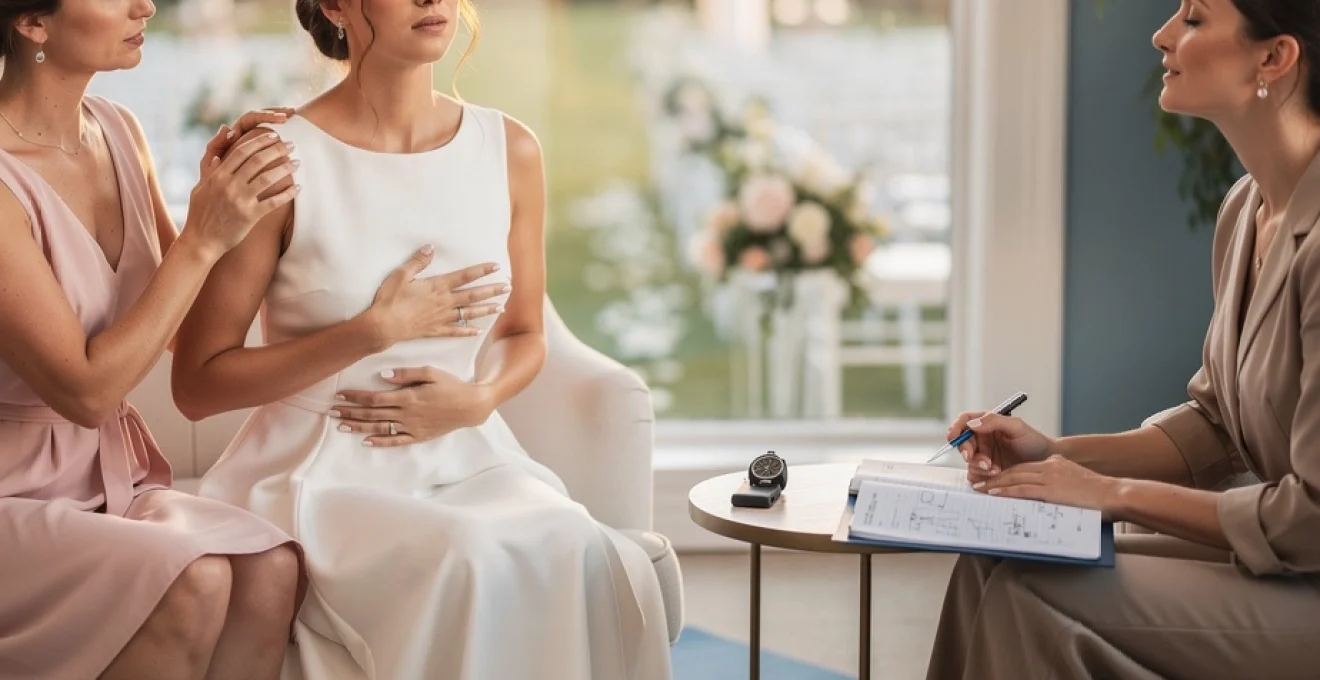
The final weeks before your wedding day can transform even the most composed individuals into anxious bundles of nerves. Research indicates that up to 96% of couples experience some form of pre-wedding anxiety, with symptoms ranging from mild butterflies to full-blown panic attacks. The pressure to orchestrate the « perfect day » while managing family dynamics, financial stress, and logistical complexities creates a perfect storm for overwhelming emotions.
Understanding that wedding anxiety is not only normal but expected can provide significant relief. Your nervous system responds to the anticipation of this major life event as it would to any high-stakes situation, triggering physiological and psychological responses designed to protect you. However, when these responses become overwhelming, they can overshadow the joy and excitement that should characterise this special time.
The good news is that evidence-based techniques can effectively manage these intense emotions. Professional therapeutic approaches, combined with mindfulness practices and physiological interventions, offer powerful tools for regaining emotional equilibrium. By implementing these strategies, you can transform pre-wedding anxiety into manageable excitement and ensure you’re emotionally present for one of life’s most significant moments.
Physiological stress response management through Evidence-Based breathing techniques
When wedding anxiety strikes, your body’s sympathetic nervous system activates, releasing stress hormones like cortisol and adrenaline. This physiological response manifests as rapid heartbeat, shallow breathing, muscle tension, and digestive disturbances. Controlled breathing techniques serve as powerful antidotes to this stress response, directly influencing your autonomic nervous system and promoting a state of calm alertness.
Scientific research demonstrates that specific breathing patterns can reduce cortisol levels by up to 68% within just five minutes of practice. These techniques work by stimulating the vagus nerve, which signals your brain to activate the parasympathetic nervous system—your body’s natural relaxation response. The beauty of breathwork lies in its accessibility; you can practice these methods anywhere, from your bridal suite to the car journey to your venue.
Box breathing method for parasympathetic nervous system activation
Box breathing, also known as four-square breathing, creates a rhythmic pattern that immediately calms your nervous system. This technique involves breathing in equal counts of four, creating a « box » pattern that regulates your heart rate variability. Navy SEALs and emergency responders use this method to maintain composure under extreme pressure, making it ideal for wedding day nerves.
To practice box breathing, inhale through your nose for four counts, hold your breath for four counts, exhale through your mouth for four counts, then hold empty for four counts. Repeat this cycle for 3-5 minutes, focusing entirely on the counting rhythm. The structured nature of this technique gives your anxious mind something concrete to focus on while your body naturally relaxes.
4-7-8 pranayama technique for cortisol reduction
The 4-7-8 breathing technique, rooted in ancient pranayama practices, specifically targets cortisol reduction and promotes rapid relaxation. This method involves inhaling for four counts, holding for seven counts, and exhaling for eight counts. The extended exhalation activates your parasympathetic nervous system more effectively than equal-count breathing patterns.
Research published in the International Journal of Yoga found that practitioners of 4-7-8 breathing experienced a 23% reduction in cortisol levels after just eight weeks of regular practice. For immediate wedding anxiety relief, practice this technique for four complete cycles, allowing your body to sink deeper into relaxation with each round. The longer exhalation helps expel tension and worry while the retention phase allows oxygen to fully circulate through your system.
Coherent breathing pattern for heart rate variability optimisation
Coherent breathing involves maintaining a steady rhythm of five breaths per minute, creating optimal heart rate variability and promoting emotional coherence. This technique synchronises your heart rhythm, breathing pattern, and brainwave activity, creating a state of physiological harmony that directly counteracts anxiety symptoms.
To practice coherent breathing, inhale for six counts and exhale for six counts, maintaining this 12-second cycle for 5-10 minutes. Focus on breathing smooth
and even, without forcing it, allow your breath to move slightly down into your belly. Many people find it helpful to use a free breathing app or a simple timer to keep a steady rhythm. Coherent breathing is particularly useful in the car on the way to your venue or during hair and makeup, when your mind might otherwise spiral through “what if” scenarios.
Alternate nostril breathing for autonomic balance restoration
Alternate nostril breathing, or nadi shodhana, has been shown in multiple small studies to help balance activity between the left and right hemispheres of the brain and restore autonomic balance. For last-minute wedding nerves, this means your body can shift from a fight-or-flight response into a more regulated, centred state. It is especially helpful if you feel emotionally “all over the place” or notice mood swings in the hours before the ceremony.
To practice, sit upright and place your left hand on your lap. With your right hand, use your thumb to gently close your right nostril and inhale slowly through your left nostril. At the top of the inhale, close the left nostril with your ring finger, release your thumb, and exhale through the right nostril. Then inhale through the right nostril, close it, and exhale through the left. This completes one cycle. Continue for 1–3 minutes, focusing on the sensation of air moving in and out. The steady pattern gives your anxious mind a simple, soothing task, much like tracing a calm route through a busy map.
Cognitive behavioural restructuring for Pre-Ceremony anxiety disorders
While breathing techniques calm the body, cognitive behavioural strategies help you manage the thoughts that often fuel last-minute wedding nerves. Cognitive Behavioural Therapy (CBT) is widely recognised as a gold-standard treatment for anxiety disorders, with research suggesting that up to 60–80% of people experience significant symptom reduction. On your wedding day, you may not be starting full therapy, but you can still borrow targeted CBT tools to challenge unhelpful beliefs and regain perspective.
Many pre-ceremony worries fall into predictable thinking patterns: catastrophising about everything going wrong, perfectionism about the “ideal” wedding, or imposter syndrome about whether you deserve this happiness. Learning to spot and shift these patterns can be the difference between feeling trapped in your head and being able to enjoy walking down the aisle. Think of CBT as mental scaffolding that helps you feel steady while emotions run high.
Catastrophic thinking pattern identification and interruption
Catastrophic thinking is when your mind jumps straight from a small concern to the worst possible outcome. For example, “The flowers are late, so the ceremony will be ruined, everyone will be disappointed, and they’ll think we’re disorganised.” Sound familiar? These thoughts can spike your heart rate and make nervousness feel unmanageable. The first step is simply to notice when your thoughts start using phrases like “always,” “never,” or “ruined.”
Once you have identified a catastrophic thought, you can interrupt it using a quick three-step process: pause, label, and question. Silently say to yourself, “Pause. This is catastrophising.” Then ask, “What is the most likely outcome, not the worst one?” and “If the worst did happen, how would I cope?” Often, you realise that even imperfect scenarios are survivable. This shift from “I’m helpless” to “I can cope” reduces anxiety and helps you respond calmly to last-minute changes, whether it is the weather, timing, or a missing buttonhole.
Rational emotive behaviour therapy techniques for perfectionism
Rational Emotive Behaviour Therapy (REBT), a branch of CBT, focuses on challenging rigid “musts” and “shoulds.” Perfectionism before a wedding often sounds like, “Everything must go exactly to plan,” or “I should look flawless all day.” These beliefs create intense pressure and make minor hiccups feel like personal failures. REBT invites you to move from harsh demands to more flexible preferences.
To apply this, write down one anxious perfectionist belief, such as, “Our wedding must be perfect, or it will be a disaster.” Then, dispute it using three questions: “Is this belief logical?”, “Is it helpful?”, and “Is it realistic?” Replace it with a more rational statement like, “I want our wedding to go well, but it doesn’t have to be perfect for it to be meaningful and joyful.” You can even jot these new statements on a note in your phone or give them to a trusted friend to read back to you if panic rises on the day. Over time, this practice transforms a pressure-cooker mindset into one that allows for human moments and genuine connection.
Thought stopping methods for intrusive worry cycles
In the final 24–48 hours, you may find the same worries looping in your mind: “Will guests enjoy themselves?”, “What if I trip?” or “What if I cry too much?” Intrusive thoughts like these are common, but when they become repetitive they can feel exhausting. Thought stopping is a brief, practical technique designed to interrupt these loops and give your brain a reset.
Choose a simple cue word or phrase such as “Stop,” “Pause,” or “Not now.” When you notice your mind starting a familiar worry cycle, firmly say your cue word in your head (or quietly out loud if you are alone). Then immediately redirect your attention to a grounding task: counting backwards from 20, naming five things you can see, or doing 30 seconds of box breathing. With practice, your brain starts to associate the cue word with shifting attention, much like pressing a mental “mute” button on unhelpful noise.
Cognitive reframing strategies for imposter syndrome
Many people are surprised to feel imposter syndrome around their wedding. You might think, “Do I really deserve this love?” or “Everyone thinks I’m more put together than I am.” These thoughts can create a subtle sense of fraudulence and make it hard to receive affection or compliments on the day. Cognitive reframing helps you view the same situation through a kinder, more accurate lens.
Start by writing or mentally noting the imposter thought, for example, “Everyone is here for the show, not for me.” Then ask, “What evidence do I have that contradicts this?” Perhaps friends booked flights months in advance, or your partner has supported you through difficult seasons. Replace the original thought with a balanced one: “Our guests are here because they care about us, even if I don’t feel confident every second.” Imagine you were speaking to a close friend in your position—what would you say to them? Offering yourself that same compassion helps strip away the harsh inner critic and allows you to step into your wedding day as the real, imperfect you.
Progressive muscle relaxation protocol for somatic anxiety symptoms
When last-minute wedding nerves build, anxiety is often felt most acutely in the body: tight shoulders, clenched jaw, churning stomach. Progressive Muscle Relaxation (PMR) is a structured technique that systematically tenses and releases different muscle groups, signalling to your brain that you are safe. Numerous clinical studies show PMR can reduce physical anxiety symptoms, improve sleep, and even lower blood pressure when practised regularly.
Think of PMR like a “body reset” button. Find a quiet space—this could be a hotel room, a side room at your venue, or even a parked car. Starting at your feet, gently tense the muscles for 5–7 seconds as you inhale, then release completely as you exhale and notice the contrast between tension and relaxation. Gradually move upwards through calves, thighs, hips, stomach, hands, arms, shoulders, neck, and face. If you are wearing clothes you do not want to wrinkle, you can adapt by focusing on smaller, subtler squeezes, particularly in your hands and shoulders.
This technique is particularly effective the night before your wedding to aid sleep, or during the morning if you notice shaking hands or a restless, buzzing feeling in your limbs. You can even combine PMR with breathing techniques, exhaling slowly as you release each muscle group. Over time, your body learns the new pattern: instead of escalating tension when you are stressed, it remembers how to actively let go, much like learning a choreography for calm.
Emergency mindfulness interventions for acute panic episodes
Despite careful planning and preparation, intense spikes of anxiety or even brief panic attacks can still occur on the morning of your wedding or just before the ceremony. Rather than seeing this as a failure, it is more helpful to view it as your nervous system doing what it has learned to do under stress. Emergency mindfulness techniques, including somatic exercises for nervous system regulation, offer fast, practical ways to anchor yourself back in the present, reduce the intensity of the episode, and prevent dissociation.
These interventions are not about becoming instantly blissful or zen. Instead, they work like emotional first aid: enough to stabilise you so that you can continue with your day. The following tools are especially effective because they engage your senses, body awareness, and attention—all powerful antidotes to spiralling thoughts.
5-4-3-2-1 grounding technique for dissociation prevention
The 5-4-3-2-1 grounding technique is a simple sensory exercise commonly used by therapists and first responders to help people manage acute anxiety. It is particularly useful if you feel “out of body,” numb, or like everything is happening in a blur. By systematically naming your sensory experiences, you bring your attention back into the present moment and into your surroundings.
Here is how to use it if panic builds while you are waiting to walk down the aisle or during a quiet moment before the ceremony:
- Notice and name 5 things you can see (for example, the pattern on the carpet, the flowers, the light through a window).
- Notice and name 4 things you can feel (your feet on the floor, fabric against your skin, the weight of your bouquet).
- Notice and name 3 things you can hear (music in the distance, quiet conversation, your own breath).
- Notice and name 2 things you can smell (perfume, fresh air, flowers).
- Notice and name 1 thing you can taste (water, mint, or simply the taste in your mouth).
Move through the steps at your own pace, breathing slowly as you do. This exercise works much like gently re-rooting a plant that has been shaken—your mind reconnects with the safety of the here-and-now rather than the imagined catastrophic future.
Body scan meditation for present-moment awareness
A brief body scan meditation can be invaluable if you feel your thoughts racing ahead to speeches, dances, or family interactions. Instead of trying to control every variable, you simply bring awareness to what is happening inside your body right now. Research shows that body scanning can reduce anxiety and improve emotional regulation, even when practised for just 5–10 minutes.
To try this, close your eyes if you feel comfortable (or soften your gaze). Starting at the top of your head, slowly move your attention down through your forehead, jaw, neck, shoulders, chest, arms, hands, stomach, hips, legs, and feet. At each point, silently ask, “What sensations can I notice here?” without trying to change anything. You might feel warmth, tingling, tightness, or nothing at all. Simply noticing these sensations without judgement helps to unhook you from anxious stories and brings you back to your own experience—like tuning a radio away from static back to a clear signal.
Mindful observation practice for racing thoughts
When your mind is spinning with guest lists, timings, and social worries, mindful observation gives you a neutral focus. Instead of engaging with every thought, you choose one object or element in your environment and study it carefully for 1–3 minutes. This could be a candle flame, a flower arrangement, your partner’s handwriting on a note, or even your own hands.
Gently describe the object in your mind: its colours, shapes, textures, and how light falls on it. Each time your thoughts wander back to worries, kindly redirect your attention to the object, as you would bring back a puppy that has wandered off. This simple act of sustained, curious attention calms your nervous system and builds the skill of letting thoughts come and go without being dragged along by them. It is a small practice with a big impact, especially in those last quiet minutes before everything begins.
Professional support network activation and crisis management planning
One of the most powerful ways to manage last-minute wedding nerves is to remember that you do not have to cope alone. Activating a support network—from your partner and wedding party to professional therapists or coaches—creates a safety net around you. Knowing in advance who will do what if you feel overwhelmed can significantly reduce anticipatory anxiety. In many ways, this is like having a well-thought-out contingency plan for your emotions, just as you might for the weather.
Start by choosing two or three “go-to” people for emotional support on the day. This might include your maid of honour, best man, a sibling, or a close friend who knows your anxiety history. Brief them ahead of time about what tends to help you: perhaps a quick walk outside, a glass of water, breathing together for a minute, or reading a reassuring message you have written to yourself. You can even create a simple crisis plan in your phone notes outlining steps to follow if you experience a panic attack or feel like running away.
If you already see a therapist or counsellor, consider scheduling a session in the week of your wedding to rehearse these strategies and personalise them. For some couples, investing in a few sessions of pre-marital counselling or anxiety-focused therapy in the months leading up to the wedding offers both relationship tools and emotional coping skills. And if you notice that your anxiety remains intense or begins to affect your sleep, appetite, or day-to-day functioning, it is wise to seek professional help rather than waiting for it to pass on its own.
On the day itself, remember that your vendors—planners, photographers, venue coordinators—can also be part of your support team. Many are experienced at spotting when nerves peak and can quietly adjust timelines or create brief pauses for you to regroup. Communicate your needs clearly in advance, and do not be afraid to say, “I need five minutes.” Ultimately, managing last-minute wedding nerves is not about eliminating anxiety completely; it is about having practical tools, trusted people, and a flexible plan so that you can feel grounded enough to experience the joy, emotion, and meaning of the commitment you are making.