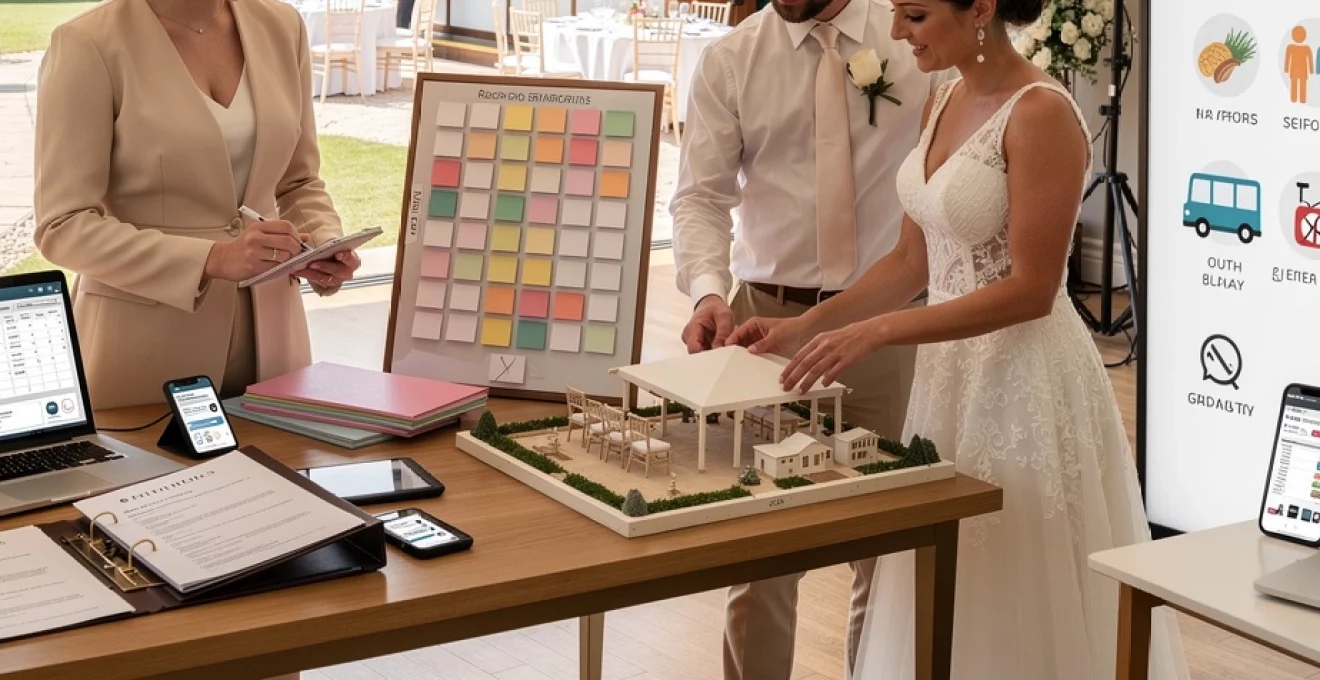
Planning a wedding transforms from an exciting dream into a complex logistical challenge that requires meticulous attention to detail. The difference between a chaotic wedding day and a seamlessly orchestrated celebration lies in the foundation of organization established months before the ceremony begins. Modern couples face an overwhelming array of decisions, from selecting the perfect venue to coordinating multiple vendors, managing guest communications, and ensuring legal compliance.
A well-organized wedding operates like a finely tuned orchestra, where every element harmonizes to create an unforgettable experience. The key lies not just in having all the necessary components, but in strategically organizing them to work together efficiently. This systematic approach reduces stress, prevents costly mistakes, and ensures that the focus remains on celebrating love rather than managing crises.
Pre-wedding timeline management and vendor coordination strategies
Effective wedding organization begins with establishing a comprehensive timeline that serves as the backbone of your entire planning process. The most successful weddings follow a structured approach that allows adequate time for decision-making, vendor booking, and contingency planning. Without proper timeline management, even the most beautiful wedding elements can become sources of stress rather than joy.
12-month wedding planning timeline with critical milestone checkpoints
The twelve-month planning timeline represents the gold standard for wedding organization, providing sufficient time to secure preferred vendors and venues while avoiding the premium pricing often associated with last-minute bookings. Your timeline should begin with venue selection and engagement announcements, progressing through vendor interviews and contract negotiations during months 10-8. The middle phase, months 7-4, focuses on detailed planning including menu finalization, invitation design, and dress fittings.
Critical checkpoints occur at specific intervals throughout this timeline. The six-month mark requires confirmation of all major vendors, completion of guest list compilation, and initiation of invitation ordering. Three months before your wedding date, final headcounts must be submitted to caterers, seating charts should be drafted, and ceremony details finalized. The final month demands completion of all administrative tasks, including vendor timeline distribution and emergency contact list preparation.
Vendor contract negotiation techniques and payment schedule optimisation
Strategic vendor management extends beyond simply hiring service providers; it involves creating a network of professionals who understand your vision and work collaboratively toward your wedding goals. Successful contract negotiation begins with thorough research into vendor backgrounds, reading reviews, and requesting detailed proposals that outline exactly what services are included in quoted prices.
Payment schedule optimization protects both your financial interests and ensures vendor accountability. Standard industry practice involves a booking deposit of 25-50% upon contract signing, with subsequent payments scheduled at specific intervals leading up to your wedding day. Never pay the full amount upfront, as this removes your leverage should services not meet contracted standards. Instead, structure payments to coincide with delivery milestones, with final payments due only after satisfactory completion of services.
Wedding insurance coverage options: marquee & marquee, WedSafe, and john lewis finance
Wedding insurance serves as a crucial safety net that protects your investment against unforeseen circumstances. The average UK wedding costs £31,974, making insurance coverage an essential component of responsible wedding planning. Comprehensive policies typically cover venue cancellations, vendor no-shows, extreme weather conditions, and personal liability issues that could arise during your celebration.
When evaluating insurance options, consider coverage limits, exclusions, and claim processes. Some policies exclude certain weather conditions or require specific notice periods for cancellations. Read policy documents carefully and ensure that your coverage amounts reflect the true cost of your wedding, including non-recoverable deposits and expenses that would be incurred in rebooking services.
Digital project management tools: trello wedding boards and bridebook platform integration
Modern wedding organization benefits tremendously from digital project management tools that centralize information and streamline communication between all parties involved in your celebration. These platforms transform overwhelming task lists into manageable, trackable projects that provide clear visibility into planning progress and upcoming deadlines.
Trello’s visual board system allows you to create cards for each wedding element, moving them through stages from « Ideas » to « In Progress » to « Completed. » This visual approach helps identify bottlenecks and ensures nothing falls through the cracks. Integration with other tools
Trello can be synchronized with shared calendars and checklists, allowing your partner, planner, and key vendors to see updates in real time. Bridebook offers an integrated UK-focused planning platform with budgeting tools, vetted supplier directories, and timeline reminders. Using Bridebook alongside Trello gives you both a big-picture roadmap and a granular task manager, minimizing the risk of overlooked details. By centralising conversations, contracts, and checklists in these digital tools, you dramatically reduce email clutter and last-minute confusion on your wedding day.
Venue selection criteria and logistical infrastructure requirements
Once your planning framework is in place, the next pillar of a well-organized wedding is selecting a venue that can support your logistical needs as well as your aesthetic vision. A beautiful space that lacks the right infrastructure can quickly become a source of stress, especially as guest numbers grow and technical requirements increase. Evaluating potential venues through the lens of capacity, accessibility, facilities, and contingency options ensures that your celebration runs smoothly from guest arrival to final farewell.
Capacity planning calculations for ceremony and reception spaces
Accurate capacity planning goes beyond simply asking how many people a venue can hold. You should differentiate between seated ceremony capacity, seated dining capacity, and standing reception capacity, as these numbers can vary significantly. As a general guideline, allow at least 0.9–1.1 square metres per guest for seated dining and 0.6–0.8 square metres per guest for a standing drinks reception. If you plan to incorporate a dance floor, stage, or live band, factor in the additional space these elements will require.
Well-organized weddings also account for circulation space, ensuring guests can move comfortably between the bar, restrooms, and seating areas. Consider whether you will need separate spaces for the ceremony, cocktail hour, and reception, or whether a single room will be “flipped” between uses. Flipped spaces require more precise timelines and additional staff to manage transitions discreetly. When in doubt, prioritize guest comfort over maximum capacity, as overcrowded rooms can undermine even the most beautifully styled décor.
Accessibility compliance standards under the equality act 2010
In the UK, the Equality Act 2010 requires service providers, including wedding venues, to make reasonable adjustments so that disabled guests are not placed at a substantial disadvantage. From an organizational perspective, this means assessing ramps, lifts, accessible toilets, and step-free access points at your chosen venue. You should also review accessible parking availability, clear signage, and lighting levels, particularly for evening events when visibility may be reduced. A truly inclusive wedding anticipates the needs of all guests, not just those who have disclosed requirements in advance.
Ask venues specific questions about hearing loop systems, space for mobility aids, and seating options for guests who cannot stand for long periods. If a venue falls short in certain areas, explore whether temporary solutions such as portable ramps or reserved ground-floor rooms can be put in place. Documenting these accessibility arrangements in your wedding day schedule ensures that ushers, coordinators, and vendors know how to support guests effectively. By integrating accessibility into your planning from the outset, you not only comply with legal standards but also create a more welcoming, well-organized experience.
Catering kitchen specifications and licensed bar requirements
Behind every seamless wedding breakfast is a catering operation that has the right space, equipment, and licensing framework. When assessing a wedding venue, clarify whether there is a full commercial kitchen, a catering-prep area, or only minimal facilities. Full kitchens typically offer ovens, refrigeration, hand-washing stations, and adequate storage, allowing for complex plated menus and precise service times. Limited facilities may require your caterer to bring in mobile kitchen equipment, which can impact both cost and layout planning.
Licensed bar requirements are another core component of a well-organized wedding. Confirm whether the venue holds its own premises licence for the sale of alcohol and late-night refreshments, and what hours are covered. If you intend to bring in your own alcohol (for example, for a signature cocktail bar), ask about corkage fees and glassware provision. You should also review responsible service policies, staffing ratios, and whether the bar can handle payment systems such as contactless cards. Clear agreements in these areas help prevent delays at the bar and ensure compliance with local licensing regulations.
Power supply assessment for audio-visual equipment and lighting systems
Modern weddings often rely on a complex network of audio-visual equipment, from sound systems and DJ rigs to fairy lights and photo booths. Conducting a power supply assessment with your venue and production vendors is essential to avoid overloads and failures. Ask for details of available circuits, total amperage, and the location of power outlets in relation to the dance floor, band area, and catering stations. A professional AV company can then specify distribution boards, extension leads, and surge protection devices that comply with safety standards.
Think of your wedding’s electrical setup as the nervous system of the event: if it fails, many key experiences are disrupted. For outdoor or marquee weddings, you may need to hire silent generators with sufficient capacity for lighting, sound, and catering equipment. Build in redundancy where possible, such as separate circuits for lighting and sound, so that a fault in one area does not plunge your entire reception into darkness. Confirm that all equipment carries up-to-date PAT (Portable Appliance Testing) certification and that emergency lighting is available should a power cut occur.
Weather contingency planning for outdoor ceremonies and marquee installations
Weather is one of the most unpredictable variables in wedding planning, particularly for outdoor ceremonies and marquee receptions. A well-organized wedding includes a robust “Plan B” that can be activated quickly if conditions change. Discuss with your venue how and when weather-related decisions will be made—often by the morning of the event—and who has authority to trigger the backup plan. Your contingency might include relocating the ceremony indoors, adding sidewalls and heating to marquees, or adjusting the timeline to accommodate sudden showers.
Marquee installations demand extra attention to ground conditions, drainage, and wind loading. Ensure your marquee supplier conducts a site visit to check for underground utilities, access for vehicles, and suitable anchoring points. Consider additional infrastructure such as walkways, matting, and covered entrance areas to keep guests comfortable and dry. By treating weather planning like an insurance policy—hoping you will not need it but preparing as if you will—you safeguard the flow of your wedding day and protect your investment in décor and entertainment.
Comprehensive guest management systems and communication protocols
Even the most thoughtfully designed wedding can feel disorganized if guest communications are fragmented or unclear. Comprehensive guest management brings together invitations, RSVPs, dietary information, transport, and seating arrangements into a coherent system. By centralizing guest data and creating consistent communication touchpoints, you ensure that everyone arrives at the right place, at the right time, with the right expectations. This level of organization not only enhances guest satisfaction but also reduces the burden on you and your planning team.
RSVP tracking technology: paperless post and the knot guest list integration
Digital RSVP tools have transformed the way couples manage guest responses, particularly for larger weddings where manual tracking quickly becomes unmanageable. Platforms such as Paperless Post allow you to send beautifully designed invitations and monitor opens, bounces, and replies in real time. The Knot’s guest list manager integrates RSVPs with seating plans, meal choices, and accommodation details, creating a single source of truth for all guest-related data. This integration supports a more organized wedding by eliminating duplicate spreadsheets and reducing the risk of missed responses.
When choosing an RSVP system, consider your guest demographic and their comfort with technology. You may decide to combine digital RSVPs with traditional paper options for older relatives or international guests. Clear deadlines, automated reminders, and personalized messages help keep response rates high and information accurate. By leveraging RSVP tracking technology, you free up time to focus on creative decisions while maintaining precise control over guest numbers and logistics.
Dietary requirement documentation and allergy management procedures
Managing dietary requirements is both a hospitality priority and a critical safety responsibility. A well-organized wedding captures this information early, ideally at the RSVP stage, and records it in a structured format that can be shared securely with your caterer. Common categories include vegetarian, vegan, gluten-free, dairy-free, halal, and kosher-style meals, alongside specific allergies such as nuts, shellfish, or eggs. Grouping guests by dietary category simplifies kitchen preparation and service sequencing.
Robust allergy management procedures go beyond noting preferences; they clarify cross-contamination protocols, ingredient checks, and emergency response steps. Ask your caterer how they label plates, brief service staff, and manage high-risk ingredients. Providing clearly marked place cards or discreet symbols on seating plans can help servers deliver the correct dishes without drawing undue attention to individual guests. By treating dietary documentation with the same seriousness as legal or insurance paperwork, you demonstrate care for your guests’ wellbeing and avoid last-minute confusion during the meal service.
Transport coordination for guest accommodation and venue access
Transport logistics often determine whether your wedding feels effortless or chaotic from a guest perspective. If your ceremony and reception venues are in different locations, or if many guests are travelling from out of town, structured transport coordination becomes essential. Options might include chartered coaches, shuttle buses between hotels and the venue, or pre-booked taxis with clear instructions. You should also provide detailed driving directions, parking information, and estimated travel times on your wedding website or information cards.
Think of guest transport as a chain: if one link fails, arrival times, ceremony start, and catering schedules can all be affected. Build in buffer time for traffic and unexpected delays, particularly for urban venues or rural locations with narrow access roads. Designate a point of contact—such as an usher or coordinator—to manage communications with drivers and respond to issues on the day. By mapping out these movements in advance, you minimize late arrivals and ensure that guests can relax and enjoy the occasion without logistical worries.
Seating plan algorithms and table configuration optimisation
Designing a seating plan can feel like solving a complex puzzle of relationships, preferences, and practical constraints. Approaching it methodically—almost like an algorithm—helps transform a potentially stressful task into a manageable process. Start by grouping guests into categories such as immediate family, extended family, close friends, colleagues, and children. Then, consider interpersonal dynamics: who should be seated together, who might prefer space, and where to place guests of honour or elderly relatives for easy access and audibility.
Table configuration plays a significant role in both the visual impact and flow of your reception. Long banquet tables encourage communal dining and work well in barn-style venues, while round tables can create more intimate clusters and make conversation easier. Consider line-of-sight to speeches, the dance floor, and any focal décor elements such as floral installations. Digital tools and wedding planning platforms allow you to drag and drop guests between tables, testing different layouts before finalising your chart. By treating seating as a strategic design choice rather than a last-minute chore, you support smoother service and a more harmonious guest experience.
Professional vendor portfolio assembly and quality assurance
A well-organized wedding relies on a carefully curated team of professionals who understand your expectations and deliver consistent quality. Building a vendor portfolio involves more than selecting the most visually impressive options; it requires assessing reliability, communication style, and compatibility with your budget and timeline. Begin by identifying core categories—such as photography, videography, floristry, catering, entertainment, cake design, and hair and makeup—and ranking them by priority based on your vision.
Quality assurance starts with thorough research, including reading recent reviews, studying full galleries rather than highlight reels, and verifying insurance and licensing where relevant. Whenever possible, schedule consultations to evaluate chemistry and responsiveness, asking detailed questions about backup plans, staffing levels, and equipment redundancy. Contracts should specify deliverables, timelines, set-up and breakdown responsibilities, and contingency policies. Keeping all vendor documents, contact details, and agreed schedules in a central digital folder or project management tool allows you to share a unified master schedule closer to the date.
To further safeguard quality, consider implementing a simple reference check system, asking venues or other suppliers about their experience of working with your chosen vendors. Many venues maintain preferred supplier lists for a reason: these professionals understand the site’s logistics and have proven track records. While you are not obliged to choose only from these lists, aligning at least some of your team with venue recommendations can streamline communication and reduce risk. Over time, your vendor portfolio becomes the backbone of your wedding organization, turning a complex event into a coordinated, professional production.
Legal documentation and ceremonial compliance framework
Amid the excitement of styling, menus, and music, the legal framework of your wedding can sometimes be overlooked. Yet, without proper documentation and compliance, the ceremony may not be legally binding, creating serious complications later. In the UK, civil and religious ceremonies each carry distinct requirements, from notice periods to approved premises regulations. A well-organized wedding treats these legal steps as fixed milestones within the planning timeline, ensuring all paperwork is completed accurately and on time.
Core legal tasks typically include giving notice of marriage or civil partnership at your local register office (usually at least 28 days before the ceremony), verifying identity and residency documents, and confirming that your chosen venue is licensed for civil ceremonies. Religious ceremonies may have additional requirements, such as banns readings or meetings with officiants. You should also clarify who is responsible for bringing and safeguarding the marriage schedule or register on the day, and how signed documents will be returned to the appropriate authority.
Ceremonial compliance extends to the structure and content of the ceremony itself. Civil ceremonies in England and Wales, for example, must not include religious content such as hymns or readings from sacred texts, whereas religious ceremonies will follow specific liturgical formats. If you wish to include symbolic elements—such as handfasting, unity candles, or cultural rituals—discuss these with your officiant to ensure they are permissible and safely integrated. By aligning creative ideas with legal guidelines, you avoid last-minute changes and maintain the smooth, organized flow of your wedding day.
Wedding day execution protocol and emergency response planning
The final layer of a well-organized wedding is the execution protocol that governs what happens on the day itself. Think of this as your event’s operating manual: a detailed timeline, responsibility matrix, and contingency plan rolled into one. A comprehensive day-of schedule should outline every major activity—from hair and makeup to last dance—alongside times, locations, and responsible parties. Sharing this document with vendors, your venue coordinator, and key members of the wedding party ensures everyone understands the plan and their role within it.
Emergency response planning is your safety net for unexpected challenges, whether they involve health incidents, technical failures, or severe weather. Designate a small crisis-management team—often a planner, venue manager, and a trusted friend or family member—who are briefed on emergency procedures, contact numbers, and decision-making authority. Basic provisions might include a well-stocked first-aid kit, spare umbrellas, sewing supplies, stain-removal wipes, and backup copies of speeches and playlists. More complex plans could cover evacuation routes, generator hire contacts, or alternative photography locations if conditions change.
By treating your wedding like a professionally produced event, you create space for spontaneity and joy within a stable framework. Guests experience a celebration that feels effortless, while behind the scenes, a robust organizational structure quietly keeps everything on track. Ultimately, the must-have elements of a well-organized wedding—timelines, logistics, guest management, legal compliance, vendor coordination, and contingency planning—work together to protect what matters most: your ability to be fully present in each moment of your day.