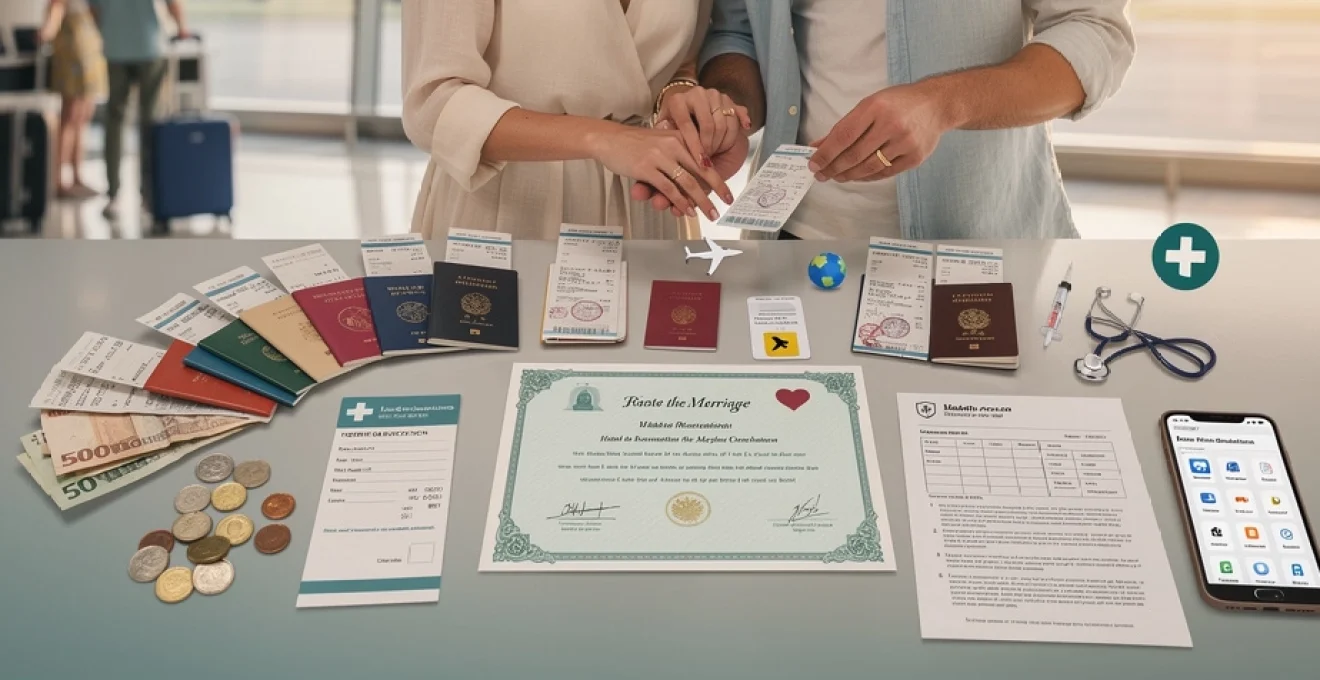
Planning an international honeymoon represents one of the most exciting aspects of your wedding preparations, yet it requires meticulous attention to documentation requirements that can make or break your romantic getaway. The complexity of international travel documentation has increased significantly in recent years, with various countries implementing stricter entry requirements, health protocols, and verification processes. Many couples discover too late that their dream destination requires specific documentation that takes weeks or even months to obtain, potentially derailing their carefully planned romantic escape. Understanding the comprehensive documentation landscape ensures your honeymoon begins smoothly, allowing you to focus on creating unforgettable memories rather than navigating bureaucratic challenges at airport immigration counters.
Essential travel documentation for international honeymoon destinations
International honeymoon travel requires a comprehensive suite of documentation that extends far beyond simply possessing valid passports. The foundation of successful international travel lies in understanding that different destinations impose varying requirements, with some countries maintaining stringent entry protocols whilst others offer more relaxed approaches to visitor documentation. Travel industry statistics reveal that approximately 30% of honeymoon trips experience delays or complications due to inadequate documentation preparation, highlighting the critical importance of thorough planning.
The modern landscape of international travel documentation has evolved considerably, particularly following global events that reshaped security protocols and health requirements. Couples planning international honeymoons must now navigate a complex web of requirements that can include everything from basic identification to specialized health certificates. The key to successful documentation preparation lies in understanding that each destination country maintains its own specific requirements, and these can change with little notice based on diplomatic relations, security concerns, or public health considerations.
Passport validity requirements and Six-Month rule applications
The six-month passport validity rule represents one of the most commonly misunderstood aspects of international travel documentation. This requirement stipulates that your passport must remain valid for at least six months beyond your planned departure date from the destination country, not just your arrival date. Many popular honeymoon destinations, including Thailand, Indonesia, Egypt, and most African countries, strictly enforce this rule, refusing entry to travellers whose passports fall short of the six-month threshold.
Standard passport processing currently takes between 8-12 weeks for routine applications, with expedited processing available for an additional fee within 5-7 weeks. However, during peak travel seasons from May through August, these timeframes can extend significantly due to increased demand. Couples should particularly consider that if either partner is changing their name following marriage, additional documentation and processing time may be required. The most efficient approach involves applying for passport renewals immediately after booking your honeymoon destination, providing ample buffer time for any unexpected delays.
Certain countries impose even stricter passport validity requirements, with some demanding up to 12 months of remaining validity. Popular honeymoon destinations in South America, including Brazil and Argentina, often require extended validity periods, whilst European Union countries generally accept the standard six-month rule. Understanding these nuances prevents the devastating disappointment of being denied boarding or entry due to insufficient passport validity.
Visa processing timeframes for popular honeymoon countries
Visa requirements vary dramatically based on your nationality and intended destination, with processing times ranging from same-day approvals to several months for complex applications. Popular honeymoon destinations such as India, China, Russia, and Brazil require advance visa applications, with processing times typically ranging from 2-4 weeks for tourist visas. However, some countries offer expedited processing services for additional fees, reducing wait times to as little as 3-5 business days.
The visa application process often requires extensive documentation beyond basic passport information. Most countries require proof of accommodation bookings, return flight tickets, financial statements demonstrating sufficient funds, and completed application forms with passport-quality photographs. Some destinations, particularly those in Africa and Asia, may also require vaccination certificates or health clearances as part of the visa application process.
Visa applications submitted during peak travel seasons or holiday periods can experience processing delays of up to 50% longer than standard timeframes, making early application submission critical for honeymoon planning.
Electronic visa systems have streamlined the application process for many destinations, with countries like Turkey, Sri Lanka, and Kenya offering convenient online visa platforms. These e-visa systems typically provide faster processing times and eliminate the need for embassy visits, though they still require advance planning and proper documentation. Understanding which destinations offer electronic visa options versus requiring traditional embassy applications helps couples plan their documentation timeline more
efficiently and reduces the risk of last‑minute complications. As a rule of thumb, aim to finalise all visa-related documentation at least six weeks before departure, and double‑check entry rules again a fortnight before you travel in case of late regulatory changes.
ESTA authorization for US territory honeymoons in hawaii and virgin islands
Honeymoons to Hawaii or the US Virgin Islands are technically domestic US trips, but for non‑US citizens they still fall under standard US entry rules. Many couples are surprised to discover that even if they are only transiting through the US on their way to a Caribbean resort, they may need Electronic System for Travel Authorization (ESTA) approval in advance. ESTA applies to citizens of Visa Waiver Program (VWP) countries, who must receive authorization at least 72 hours before boarding a flight to or via the United States.
The ESTA application process is completed online and usually takes just a few minutes, although approvals can occasionally take longer if additional checks are needed. An approved ESTA is normally valid for two years or until your passport expires, whichever comes first, and covers multiple short trips of up to 90 days. However, changes in personal circumstances, such as a new passport, name change, or certain criminal or immigration issues, may require a fresh application even within that two‑year window.
If you are not eligible for the Visa Waiver Program, you will need to apply for a B‑2 tourist visa at a US embassy or consulate, which can take several weeks and involves in‑person interviews. Couples should verify their status early, particularly if they plan complex itineraries that include stopovers in Hawaii or the US Virgin Islands en route to other destinations. Treat ESTA or visa approval as a non‑negotiable item on your international honeymoon checklist, as airlines are legally obliged to deny boarding to passengers without the correct authorization.
Schengen area documentation for european romantic getaways
European honeymoons to destinations such as France, Italy, Greece, or Spain often fall within the Schengen Area, a zone of 27 European countries that share a common visa policy. For nationalities that require a Schengen visa, the process can appear complex at first glance, but it becomes manageable when broken into clear steps. The key principle is that you apply at the embassy or consulate of the country where you will spend the most nights, or where you will first enter if the duration is equal across several countries.
Short‑stay Schengen visas generally allow stays of up to 90 days within any 180‑day period and require a detailed set of supporting documents. These typically include proof of confirmed accommodation for your entire stay, return or onward flight bookings, travel insurance with at least €30,000 of medical coverage, and evidence of sufficient financial means. Many consulates now require appointments booked weeks in advance, and processing times can range from 10–30 calendar days depending on season and workload.
Couples from visa‑exempt countries still need to follow specific documentation rules, including ensuring passports are valid for at least three months beyond the intended departure from the Schengen Area and contain at least two blank pages. From 2025, the EU is expected to roll out the European Travel Information and Authorisation System (ETIAS), a pre‑travel screening similar to ESTA that will apply to many visa‑exempt visitors. Building Schengen documentation into your honeymoon planning early helps you avoid stressful last‑minute embassy visits and ensures border checks are as smooth and romantic as you imagined.
Health documentation and medical clearance requirements
Health documentation for an international honeymoon has become as critical as passports and visas, particularly for destinations with strict public health controls. Depending on where you are travelling, you may need to show proof of specific vaccinations, recent test results, or medical clearances before boarding your flight or entering the country. Ignoring these requirements can lead to denied boarding, forced quarantine, or expensive last‑minute medical appointments in transit airports.
Rather than treating health documentation as an afterthought, incorporate it into your honeymoon planning timeline from the very beginning. Check official government travel advisories and the destination country’s health ministry websites at least three months before departure. Because these regulations can change rapidly in response to outbreaks or new variants, it is wise to re‑check requirements again one month and one week before you travel to ensure your information remains up to date.
Yellow fever vaccination certificates for african safari honeymoons
Yellow fever vaccination certificates are a classic example of highly specific health documentation that can catch honeymooners off guard. Many safari destinations in East and West Africa, including Kenya, Tanzania, Uganda, and Ghana, either require proof of yellow fever vaccination or reserve the right to request it if you are arriving from (or transiting through) a yellow fever–risk country. The certificate, officially known as the International Certificate of Vaccination or Prophylaxis (ICVP), is issued after you receive the vaccine at an approved clinic.
The yellow fever vaccine must usually be administered at least 10 days before you enter a country that requires proof of immunisation, and the resulting certificate is generally considered valid for life. However, certain border officials still look closely at vaccination dates, especially if your certificate is very old or requires manual verification. Pregnant travellers, individuals with compromised immune systems, or those with specific medical contraindications may be exempt from vaccination, but will need a signed medical waiver letter on official clinic letterhead.
What happens if you forget this certificate for your dream safari honeymoon? In some cases, travellers are forced to receive an emergency vaccination on arrival at significant cost, while others may face mandatory quarantine or outright refusal of entry. To avoid this, schedule an appointment with a travel health clinic as soon as you book your safari and carry your yellow fever certificate in the same secure folder as your passports and visas. A quick check of any transit countries on your route is also essential, as even a short layover in a risk area can trigger yellow fever documentation requirements at your final destination.
COVID-19 health pass and PCR test documentation
Although many destinations have relaxed or removed COVID‑19 entry rules, a number of countries and airlines still require proof of vaccination, negative PCR tests, or recovery certificates under certain conditions. Because regulations continue to evolve, think of COVID‑19 documentation like a weather forecast—it may change closer to your departure date, and you must be ready to adapt. Some destinations now operate on a tiered system, where fully vaccinated travellers enjoy simplified entry while unvaccinated visitors must present recent negative test results or undergo testing on arrival.
Typical COVID‑19 documentation includes an official vaccination certificate with QR code, a negative PCR or antigen test taken within a set window before departure (often 24–72 hours), or a recovery certificate stating that you tested positive within a defined recent period but are no longer infectious. Airlines can enforce these rules even when transit countries do not, which means you must verify requirements with both your carrier and your destination authorities. For multi‑leg itineraries, check whether tests must be timed according to your first departure or final arrival to avoid invalid results.
To keep things simple, store your COVID‑19 health pass in both digital and printed formats. Many couples save screenshots in a dedicated phone album and also carry printed copies in case of device failure or poor connectivity at airports. If testing is required, book appointments at accredited clinics that provide results with clear personal details, passport numbers, and timestamps, as these are often checked against your travel documents. By treating COVID‑19 paperwork as part of your broader international honeymoon document checklist, you reduce the likelihood of last‑minute surprises at check‑in.
Prescription medication declarations and medical letters
For many travellers, prescription medications are as essential as passports, yet the documentation that accompanies them is frequently overlooked. Some countries maintain strict controls on certain painkillers, psychiatric medications, or drugs containing codeine or pseudoephedrine, even when they are legally prescribed in your home country. Customs officers may request proof that your medication is genuinely for personal use and legally obtained, especially if you are carrying strong analgesics, injectables, or large quantities.
To avoid complications, carry all prescription medications in their original pharmacy packaging with your full name, dosage, and prescribing doctor clearly visible. Ask your doctor to provide a medical letter on official letterhead listing each medication, the condition it is used to treat, and confirmation that it is necessary for your health during travel. Ideally, this letter should include generic drug names as well as brand names, as brand recognition can vary widely between countries.
It is also sensible to pack an additional summary of your medical history and any allergies in case of emergencies abroad. If you use medical devices such as insulin pumps, CPAP machines, or syringes, request a specific travel letter explaining their purpose for security staff and border agents. Think of this documentation as your “health passport” for your international honeymoon: it reassures officials, accelerates security checks, and ensures you can continue your normal treatment routine without interruption.
Travel insurance policy certificates and coverage verification
Travel insurance documentation rarely feels romantic, but it can be the single most important set of papers you carry on an international honeymoon. Many couples underestimate the cost of overseas medical care and emergency evacuation, which can easily reach tens of thousands of dollars in remote locations or luxury resorts. Increasingly, countries and tour operators require proof of adequate travel insurance as a condition of entry or participation in activities such as diving, trekking, or adventure sports.
Your core documentation should include the full policy certificate, a summary of benefits, and a separate page or card showing emergency contact numbers that operate 24/7. Some insurers provide a digital wallet card or app; even so, it is wise to print a concise one‑page summary and store it with your passports. Ensure that the policy explicitly covers medical treatment, medical evacuation, trip cancellation, and COVID‑19 related disruptions if relevant to your destination.
Before departure, contact your insurer to confirm any country‑specific exclusions or activity limitations, especially if your honeymoon includes higher‑risk pursuits such as skiing, safari drives, or scuba diving. You should also check whether pre‑existing medical conditions are fully declared and accepted, as undeclared conditions can void coverage when you need it most. Keep in mind that in an emergency you may be required to show insurers’ documentation to local hospitals, so having it easily accessible—both in print and on your phone—can save valuable time when every minute counts.
Financial documentation and currency declaration forms
Financial documentation for an international honeymoon serves two main purposes: demonstrating that you can support yourself during your stay and complying with customs regulations on the movement of cash. Many immigration officers routinely ask visitors to show proof of sufficient funds, while customs agencies in both your home country and destination may require you to declare large sums of currency. Being well prepared ensures you can answer financial questions confidently rather than scrambling to locate statements at the immigration counter.
Core financial documents for honeymoon travel typically include recent bank statements, credit card limits, and proof of pre‑paid accommodation and flights. While digital banking apps are convenient, printed statements or downloaded PDFs stored offline offer an extra layer of reliability if roaming issues or poor signal interfere with app access. Some countries indicate specific minimum daily amounts that visitors must demonstrate—often in the range of US$50–100 per person per day—so it is worth checking official guidance and ensuring your documentation reflects this threshold.
Currency declaration rules vary by jurisdiction, but many countries require you to declare cash (and sometimes travellers’ cheques or bearer bonds) above certain limits, often US$10,000 or equivalent per family. Failing to declare large sums can result in seizure, fines, or even criminal investigation, regardless of whether the funds are legitimate honeymoon savings. If you need to travel with substantial cash—for example, to pay for a destination wedding balance—research both your departure and arrival regulations and complete any required declaration forms honestly.
For most couples, a safer strategy involves carrying a modest amount of local currency for immediate expenses and relying on a mix of credit cards and ATM withdrawals for the rest. Inform your bank of your travel dates and destinations to reduce the risk of fraud blocks, and consider carrying at least two separate cards in case one is lost or compromised. By organising your financial documentation as carefully as your passports and visas, you protect your honeymoon budget and minimise the chance of awkward money‑related delays at border control.
Marriage certificate authentication and apostille processing
While you generally do not need to present a marriage certificate for a standard tourist honeymoon, there are several scenarios where formal proof of marriage becomes important. Resorts offering special “honeymoon” rates, upgrades, or complimentary amenities sometimes request a copy of your marriage certificate to verify that you qualify. More critically, couples who plan to combine their honeymoon with a legal ceremony abroad, name‑change procedures, or local administrative processes may need an authenticated or apostilled version of their marriage certificate.
An Apostille is a form of international certification used between countries that are party to the Hague Apostille Convention. It verifies the authenticity of a public document—such as a marriage certificate—so that it can be recognised in another member country. Obtaining an Apostille usually involves sending the original document (or a certified copy) to a designated government authority, which affixes a special stamp or certificate confirming its validity. Processing times can range from a few days to several weeks depending on demand and whether you use standard or expedited services.
When might this matter for your international honeymoon? If you intend to register your marriage abroad, apply for a spousal visa while travelling, or conduct legal or financial transactions that rely on your new marital status, officials may insist on an apostilled certificate. Some couples also carry a certified copy simply as an extra identity document, particularly if one partner uses a different surname. Because original marriage certificates can be difficult to replace, consider travelling with certified copies while storing the original safely at home.
Before you leave, clarify exactly which form of certificate your destination requires—simple photocopies rarely suffice for official processes. Plan any Apostille requests as soon as you receive your marriage certificate, ideally at least eight weeks before departure to accommodate processing time and postal delays. Think of this step as future‑proofing your international honeymoon: you may not end up needing the authenticated document, but having it ready provides valuable flexibility if your plans evolve.
Accommodation confirmation and itinerary documentation
Immigration officials increasingly expect travellers to present clear evidence of where they will be staying during their trip and how long they intend to remain. For honeymooners, this usually takes the form of hotel booking confirmations, villa rental agreements, or cruise documentation paired with return or onward flight tickets. While digital confirmations on your phone often suffice, carrying printed copies can be invaluable if your battery fails or an officer requests hard‑copy evidence.
Comprehensive itinerary documentation goes beyond a simple list of hotels. A well‑organised file might include internal flight bookings, train tickets, transfer vouchers, car rental agreements, and tickets for any pre‑booked tours or experiences. Not only does this reassure border agents that you have a structured plan and intend to depart on schedule, it also makes it far easier for you to manage logistics during your trip. Think of it as the paper equivalent of your honeymoon calendar, with all the key details accessible even if your devices are offline.
Some countries require proof of onward travel as a condition of entry, particularly for visitors arriving without a pre‑arranged visa. In these cases, a confirmed return flight or a ticket to your next destination is essential; “open‑ended” plans can raise concerns with immigration officers. If you are relying on flexible or refundable bookings, make sure you still have documented proof of these reservations at the time of entry.
For multi‑country honeymoons, a short cover page summarising your itinerary—dates, destinations, and accommodation names—can be especially helpful. This straightforward document acts as a roadmap for both you and any official who needs to review your plans. By preparing accommodation confirmations and itinerary documentation as carefully as you would a wedding seating chart, you reduce friction at borders and free up mental space to enjoy the journey.
Digital document backup systems and emergency contact protocols
In an era of cloud storage and smartphones, relying solely on physical documents for an international honeymoon is both unnecessary and risky. Lost passports, stolen bags, or damaged paper copies can quickly turn a dream trip into an administrative nightmare. Digital document backup systems provide a powerful safety net, ensuring you can still access vital information even if your original paperwork goes missing. The goal is simple: create multiple layers of redundancy so that no single mishap can derail your travel plans.
An effective system usually combines three elements: secure cloud storage, offline backups on your devices, and carefully selected printed copies. Upload scanned PDFs of your passports, visas, travel insurance certificates, health records, and bookings to a secure cloud service with strong encryption and two‑factor authentication. At the same time, store key files locally on your phone and tablet in a password‑protected folder, so they remain accessible without internet access. Finally, keep essential printed copies—such as your passport photo page and insurance card—separate from the originals in your luggage or hotel safe.
Equally important are robust emergency contact protocols. Before departure, compile a concise list of emergency numbers, including local embassies or consulates, your travel insurer’s 24/7 helpline, your bank’s fraud line, and trusted family or friends at home. Share your full itinerary and contact details with at least one person who is not travelling with you, so they can assist or liaise with authorities if needed. You might even agree on a simple check‑in schedule via email or messaging apps for longer or more adventurous honeymoons.
One helpful analogy is to think of your documentation as a multi‑engine aircraft: if one engine fails (a stolen bag, a lost phone), the others keep you airborne. By combining digital backups, offline access, and clear emergency plans, you dramatically reduce the impact of unexpected events. This careful preparation allows you to relax into your international honeymoon knowing that, behind the scenes, you have built a resilient safety net for all your most important travel documents.