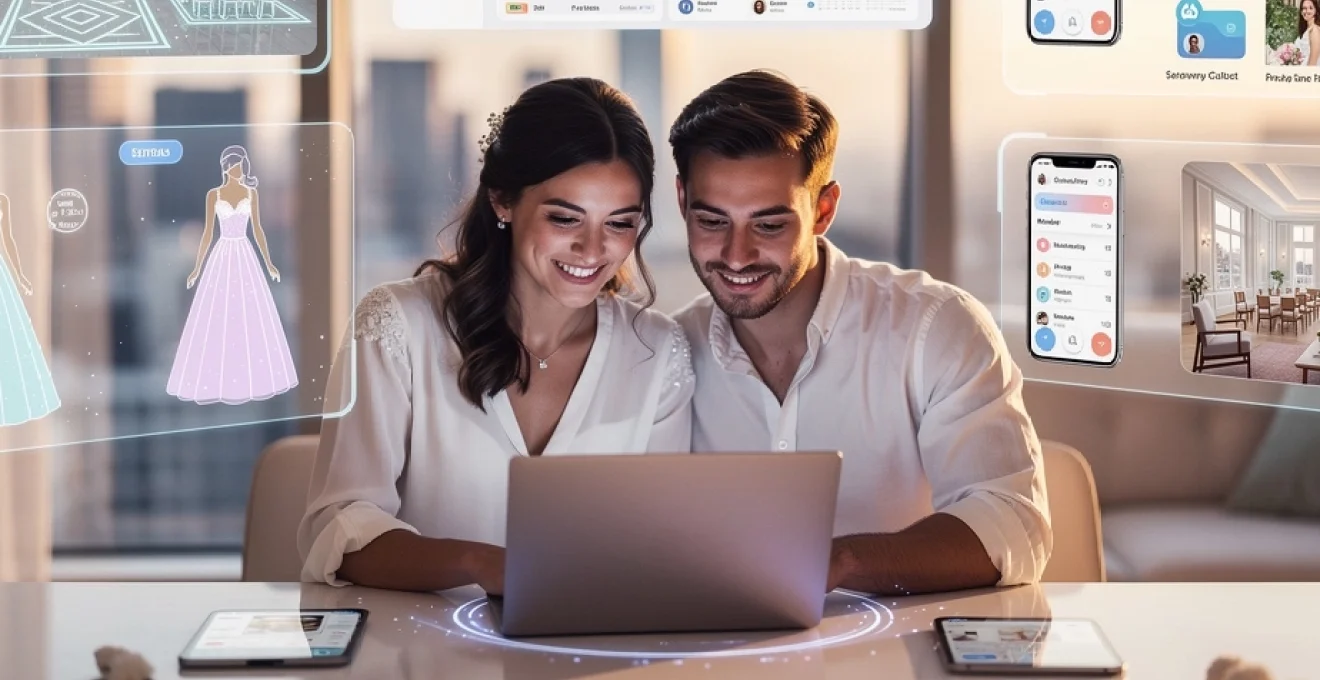
Wedding planning has undergone a revolutionary transformation over the past decade, with technology fundamentally changing how couples approach their special day. From artificial intelligence-powered design assistants to virtual reality venue tours, digital innovations are streamlining processes that once required countless hours of manual coordination. The traditional wedding planning experience, characterised by endless vendor meetings and paper-based organisation systems, is rapidly giving way to sophisticated digital ecosystems that offer unprecedented convenience and customisation.
Modern couples now expect seamless integration between their digital lives and wedding planning journey. This shift represents more than mere technological adoption; it reflects a fundamental reimagining of how weddings can be conceptualised, organised, and executed. Technology is not simply replacing traditional methods but enhancing them, creating hybrid approaches that combine the personal touch of traditional planning with the efficiency and innovation of digital solutions.
The wedding industry’s embrace of technology has accelerated significantly, with market research indicating that over 85% of couples now use digital tools during their planning process. This transformation touches every aspect of wedding preparation, from initial venue research to guest management and post-ceremony follow-up. The implications extend beyond convenience, offering couples greater creative control, improved budget management, and access to vendors and services previously beyond their geographical reach.
Digital wedding planning platforms transforming vendor discovery and management
The emergence of comprehensive digital wedding planning platforms has revolutionised how couples discover, evaluate, and manage their vendor relationships. These sophisticated systems leverage advanced algorithms and user-generated content to create personalised vendor recommendations based on couples’ specific preferences, budgets, and style requirements. The transformation from traditional word-of-mouth referrals to data-driven vendor selection represents a paradigm shift in wedding planning methodology.
Contemporary planning platforms integrate multiple functionalities within single ecosystems, enabling couples to manage everything from initial vendor research to final payment processing through unified interfaces. This consolidation eliminates the need for multiple separate tools and reduces the complexity traditionally associated with coordinating numerous wedding service providers. The platforms utilise machine learning algorithms to continuously refine their recommendation engines, becoming more accurate as they process additional user data and feedback.
Weddingwire and the knot marketplace integration systems
WeddingWire and The Knot have established themselves as dominant forces in the digital wedding planning space through their comprehensive marketplace integration systems. These platforms combine extensive vendor databases with sophisticated matching algorithms, enabling couples to filter potential service providers based on detailed criteria including budget ranges, availability windows, and style preferences. The systems incorporate real-time availability updates, ensuring couples receive accurate information about vendor scheduling and pricing.
The integration capabilities extend beyond simple vendor listings, incorporating review systems, portfolio galleries, and direct communication tools that facilitate seamless interaction between couples and potential service providers. Advanced analytics provide couples with market insights, helping them understand pricing trends and make informed decisions about vendor selection and budget allocation.
Zola and joy wedding website builder technologies
Zola and Joy have pioneered innovative wedding website builder technologies that extend far beyond simple informational pages. These platforms integrate registry management, guest communication systems, and event coordination tools within cohesive digital experiences. The website builders utilise responsive design principles, ensuring optimal functionality across desktop and mobile devices whilst maintaining aesthetic appeal.
The technological sophistication of these platforms includes automated RSVP tracking, dietary requirement collection, and guest list segmentation capabilities. Couples can create personalised experiences for different guest groups, providing targeted information about accommodation, transportation, and local attractions. The systems also incorporate social media integration, allowing guests to share content using custom hashtags while maintaining appropriate privacy controls.
Bridebook Real-Time budget tracking and analytics
Bridebook’s real-time budget tracking and analytics represent a significant advancement in financial management for wedding planning. The platform employs sophisticated algorithms to monitor spending patterns, identify potential budget overruns, and provide recommendations for cost optimisation. The system integrates with various payment processors and vendor invoicing systems, creating comprehensive financial oversight capabilities.
The analytics component provides couples with detailed insights into spending patterns, comparative market analysis, and predictive modelling for future expenses. This data-driven approach enables more informed decision-making and helps couples allocate their budgets more effectively across different wedding categories. The platform also incorporates seasonal pricing trends and regional cost variations to provide contextualised budget recommendations.
Honeybook CRM automation for wedding professionals
HoneyBook functions as a specialised CRM platform for creative professionals, including wedding planners, photographers, and venue managers, automating many of the repetitive administrative tasks that previously consumed significant time. The system centralises client communication, contract management, invoicing, and workflow automation within a single cloud-based interface. For couples, this results in faster response times, clearer proposals, and more consistent communication, as vendors can rely on pre-built templates and automated reminders rather than manual follow-ups.
Automation features extend to workflow stages such as proposal approval, deposit collection, and final balance reminders, significantly reducing the risk of missed deadlines or miscommunication. Integrated e-signature and online payment capabilities streamline the booking process, allowing couples to secure their preferred vendors in minutes rather than days. For wedding professionals managing multiple events simultaneously, HoneyBook’s pipeline view and task automation help maintain oversight and consistency, ultimately improving the overall planning experience for clients.
Virtual reality and augmented reality applications in wedding venue selection
Virtual reality (VR) and augmented reality (AR) technologies are redefining how couples research and select wedding venues. Instead of relying solely on static images or limited time during in-person tours, couples can now experience immersive, interactive representations of potential venues from anywhere in the world. This capability is especially valuable for destination weddings and for couples with demanding schedules, enabling them to narrow down options before committing to site visits.
Venue operators and planners are increasingly investing in VR and AR tools to showcase multiple layout configurations, lighting schemes, and decor styles. These technologies help couples visualise how their wedding will look in a space, minimising uncertainty and reducing last-minute design changes. In practice, VR and AR act like a digital rehearsal, giving couples confidence that the chosen venue can support their vision and logistics.
Matterport 3D virtual venue tours and spatial mapping
Matterport has emerged as a leading platform for 3D virtual venue tours, using specialised cameras and spatial mapping technology to create photorealistic digital twins of event spaces. Couples can navigate these interactive models much like a video game, moving through ballrooms, gardens, and ceremony spaces at their own pace. Unlike traditional photo galleries, Matterport tours preserve accurate room dimensions and spatial relationships, helping couples understand scale, flow, and capacity.
For wedding planning, this spatial mapping capability allows couples and planners to experiment with floor plans, furniture placement, and guest circulation before event day. Remote family members or decision-makers who cannot attend in-person tours can also access the same virtual model, making collaborative decision-making easier. As a result, venue selection becomes more data-informed and less reliant on memory or two-dimensional sketches.
AR dress fitting technology through wannaby and perfect corp
AR dress fitting tools, such as those developed by Wannaby and Perfect Corp, are transforming the bridal fashion experience by allowing virtual try-ons via smartphones and tablets. Using computer vision and body-tracking algorithms, these applications overlay digital representations of gowns onto the user’s live image, simulating fit, silhouette, and movement. While they do not yet replace in-store fittings, they serve as powerful pre-selection tools that help brides refine preferences before visiting boutiques.
For many couples, this technology reduces the time and stress associated with visiting numerous bridal shops, particularly when popular designers have limited stock in local regions. Bridal boutiques and designers benefit as well, using AR fitting apps to showcase extended collections, colour variations, and customisation options without holding every sample in-store. In essence, AR dress fitting functions as a digital fitting room that bridges inspiration platforms and physical showrooms.
Virtual cake tasting platforms and 360-degree menu visualisation
Cake designers and caterers are increasingly adopting digital tools to deliver virtual tasting experiences and 360-degree menu visualisation. While flavour still requires physical samples, many businesses now ship curated tasting boxes to couples, complemented by video consultations and interactive design sessions. High-resolution 3D models and 360-degree images allow couples to view cake designs and plated dishes from every angle, making it easier to approve intricate details remotely.
These virtual cake tasting platforms often integrate with menu planning software, enabling couples to compare portion sizes, plating styles, and presentation options alongside pricing data. For destination weddings or couples working with out-of-town vendors, this approach significantly reduces travel requirements without sacrificing customisation. It also encourages more experimentation with menu design, as couples can rapidly iterate on concepts before committing to final designs.
Immersive floral design preview using ARKit and ARCore frameworks
AR frameworks such as Apple’s ARKit and Google’s ARCore are powering immersive floral design previews, allowing couples to visualise centrepieces, arches, and aisle arrangements in real-world environments. By pointing a smartphone or tablet at a table or ceremony space, users can overlay life-size digital floral designs into the live camera feed. This helps couples understand scale, proportion, and colour harmony in context, rather than relying on 2D sketches or mood boards.
Floral designers can build libraries of digital arrangements that can be quickly adjusted for flower types, colour palettes, and vessel styles, dramatically speeding up the proposal and revision process. For couples conscious of sustainability and budget, AR previews also reduce the need for multiple physical mock-ups, saving both resources and cost. In effect, AR floral design functions like a fitting room for decor, enabling precise, low-risk experimentation before any stems are ordered.
Artificial intelligence and machine learning in wedding customisation
Artificial intelligence (AI) and machine learning (ML) are at the heart of many modern wedding planning tools, quietly powering recommendation engines, automation workflows, and predictive analytics. Rather than replacing human creativity, these systems act as digital assistants, handling data-heavy tasks and surfacing insights that would be difficult to generate manually. For couples, this means more personalised suggestions, smarter scheduling, and less time spent sifting through overwhelming volumes of options.
Machine learning models learn from past weddings, user interactions, and industry data to refine their outputs over time. As they ingest more information about style preferences, budget behaviours, and guest responses, they become better at predicting which venues, vendors, and timelines are likely to succeed. The result is a planning experience that feels increasingly tailored, even for couples who begin with only a vague sense of what they want.
Pinterest visual search API for wedding inspiration algorithms
Pinterest has long been a primary destination for wedding inspiration, and its Visual Search API now leverages computer vision to move beyond simple keyword tagging. When users save or click on an image, machine learning models analyse visual attributes—such as colour schemes, dress silhouettes, floral styles, and decor motifs—to surface similar content automatically. For couples, this translates into more accurate and nuanced inspiration feeds that reflect their evolving tastes.
Wedding planners and vendors can tap into these visual search capabilities to understand trend trajectories and client preferences. By analysing which images perform well within certain demographics or regions, professionals can tailor their offerings and marketing materials more effectively. In practice, Pinterest’s algorithms serve as a real-time pulse on the global wedding aesthetic, helping both couples and suppliers align expectations more quickly.
Chatgpt-powered wedding timeline and checklist generation
Conversational AI tools such as ChatGPT are increasingly used to generate bespoke wedding timelines, checklists, and communication templates. By answering a series of targeted questions about date, location, guest count, cultural traditions, and budget, couples can receive structured planning roadmaps in seconds. These AI-generated plans typically include vendor booking deadlines, payment milestones, and day-of schedules that can be customised further by planners.
Beyond timelines, AI writing assistants support couples in drafting speeches, vows, emails to guests, and even social media announcements. While it remains essential for couples to personalise this content, AI can alleviate writer’s block and ensure important details are not overlooked. In effect, tools like ChatGPT function as on-demand planning consultants, available 24/7 to respond to questions and produce first drafts that save significant time.
Predictive analytics for guest attendance using RSVP data mining
Predicting guest attendance has always been a challenging aspect of wedding planning, with no-shows and late confirmations affecting seating plans and catering costs. Predictive analytics tools now analyse historical RSVP data, demographic patterns, travel distances, and response behaviour to estimate likely attendance rates with greater accuracy. These models can flag guest segments that may require additional follow-up or contingency planning.
For example, if data indicates that out-of-town guests or certain age groups are historically more likely to decline, planners can adjust invitation waves or over-invite slightly to reach target headcounts. Caterers and venues benefit as well, using attendance predictions to optimise staffing levels and food quantities. By treating RSVP data as a dataset rather than a static list, couples can reduce waste, manage budgets more efficiently, and create more realistic plans.
Ai-driven photographer matching based on style recognition technology
Choosing a wedding photographer often hinges on subjective notions of « style, » which can be difficult to articulate. AI-driven matching platforms now use style recognition technology to analyse photographer portfolios and compare them with images couples mark as favourites. These systems classify attributes such as light quality, colour grading, composition, and candid versus posed emphasis, then recommend photographers whose work aligns with those preferences.
This approach streamlines vendor discovery, particularly in large markets where hundreds of photographers may be available. Instead of browsing endless profiles, couples receive a curated shortlist that reflects both aesthetic and budget parameters. Photographers also gain more qualified leads, as inquiries are more likely to come from couples who appreciate their visual approach, leading to better alignment and smoother collaboration.
Cloud-based collaborative planning tools and real-time communication systems
Cloud-based collaborative tools have become indispensable for coordinating weddings that involve multiple stakeholders across different locations. Shared planning workspaces, often embedded within platforms like Google Workspace, Notion, or specialised wedding software, allow couples, planners, and vendors to access up-to-date schedules, floor plans, and task lists from any device. This eliminates version control issues that once plagued email-based planning, where multiple attachments quickly became outdated.
Real-time communication systems, including integrated messaging within planning platforms and dedicated Slack or Microsoft Teams channels, support faster decision-making and clearer accountability. For complex weddings with several events over multiple days, these tools function like command centres, centralising discussions and documents. When a change occurs—such as a revised ceremony time or updated guest count—notifications ensure that all relevant parties are informed instantly, reducing the risk of misalignment on the wedding day.
Contactless payment solutions and digital RSVP management platforms
Contactless payment solutions and digital RSVP platforms are simplifying both financial transactions and guest management. Couples increasingly prefer to pay deposits, instalments, and final balances via secure online gateways that support cards, bank transfers, and mobile wallets. Vendors using tools like Stripe, Square, or integrated payment systems within their CRM platforms can automate invoicing, send reminders, and reconcile accounts with minimal manual input.
On the guest side, digital RSVP management platforms embedded in wedding websites or apps capture responses, meal preferences, and accessibility needs in real time. QR codes printed on invitations or shared via email link guests directly to personalised response pages, reducing errors and improving data accuracy. For couples, this means less time chasing responses and manually updating spreadsheets, and more time focusing on creative and emotional aspects of the celebration.
Social media integration and live streaming technologies for modern ceremonies
Social media integration and live streaming technologies are reshaping how weddings are shared and remembered, extending the celebration beyond the physical venue. Couples now routinely create custom hashtags, private groups, or event pages to centralise guest-generated content and communication. Professional « wedding content creators » capture behind-the-scenes footage and prepare same-day edits for platforms like Instagram and TikTok, satisfying the desire for immediate, shareable moments.
Live streaming solutions, ranging from simple smartphone setups to multi-camera productions, enable remote guests to attend ceremonies and key reception events in real time. Platforms such as Zoom, Vimeo, and YouTube Live can be embedded directly into wedding websites, often with interactive chat features that allow virtual attendees to send messages or digital toasts. This hybrid approach accommodates travel limitations, health considerations, and global guest lists while preserving the intimacy of the in-person experience.